Showing posts with label History. Show all posts

Wednesday, 16 March 2016

Another Book: Rome and Italy by Livy

I read this book right after I read his "Early History of Rome" - and that was quite some time ago. Again, to salvage what I could from my memory (thanks to my margin markings), here is what I got from this piece. Spoilers ahead, many spoilers. But then, it's not like there are any secrets here...

Rome and Italy
Livy
This book continues from Livy’s “The Early History of Rome” with five subsequent ‘books’ - 6 through 10. This work covers the period from the Gallic (Celtic) sack of Rome in 386 B.C. until when the Romans began dominating most of Italy in 292 B.C.
Book Six re-summarizes some of the events leading up to and following the Gallic sack of Rome. Important figures were Roman general Camillus, who defeated the Gauls, and defended Rome against local rivals as Rome slowly recovered from the Celtic defeat, and Manlius, a former Consul who had aspirations of the throne, and was executed. (However, this may have been just a story to cover the fact that he championed the plebeians to the disgust and anger of the patricians.) In 367 B.C., the Gauls made another attack, but were easily defeated by the Romans this time.

Book Seven covers the period from 365 to 342 B.C. Socially, rebuilding the city was a crushing financial burden to the plebeians, so changes to the rate of interest improved their lot. Militarily, just 17 years after the defeat, the Romans were able to field 10 legions. Around 350 B.C. a large Gallic army again appeared in Latin territory, and was defeated with great loss to the Gauls. Greek pirates made a show near the mouth of the Tiber, but were easily defeated when they landed. Also covered is the first conflict with the Samnites of south and central Italy, with the Romans winning several battles.

Book Eight Covers the period from 341 to 322 B.C. generally known as the first Samnite war. However, it begins with another short battle with the Volscians. Livy takes the opportunity here to describe the make-up and fighting strategy of the Roman army. A good time because the Romans now had to fight some of their fellow Latins, who had long been allies, and with whom they had fought side-by-side, and used the same weapons and techniques. The Romans won, with the unlikely aid of the Samnites, but at great cost to both sides. Rome would recover, and retain much of the territory of the vanquished Latins. And of course, more fighting against the Samnites.
Livy mentions the rise of Alexander the Great at this time, as well as the founding of the city of Alexandria in Egypt. And in 326 B.C., the Romans made a law that a creditor may seize the property of a debtor, but may not seize or imprison the debtor’s person.

Book Nine Covers the period from 321 B.C. to 304 B.C., generally known as the second Samnite war. It starts with the Roman army coming to the aid of allies being besieged by the Samnites. On their way they are ambushed by a Samnite army, and forced to give up hostages (their cavalry), to strip their uniforms and their arms, and to proceed under the yoke. Here is a paining of the event (click for more info).
Romans passing under the Samnite yoke
Having considered two options - let the Romans go, and guarantee friendship, kill them all, and guarantee a weakened Rome for a generation, they instead chose to humiliate- a decision that would do them no good in the end.
A second Roman army laid siege on an Apulian city garrisoned by Samnites and won a victory, freeing the hostages, and forcing Samnites under the yoke. The general here was Papirius Cursor, whom Livy insists could have bested Alexander the Great, had he came the way of Italy. (A bit of hubris, perhaps?)
After some treaties with Samnites and some lesser Greek cities (in the east and south of Italy), the Romans began sending envoys (patrons) who purpose was to introduce Roman law, and thus began the spread of Roman law (and culture) though Italy. As the second Samnite war drew to a close, the Romans began to be concerned with the Etruscans, and they began fighting on two fronts. Etruscans had great numbers, but were not as organized, and soon paid a heavy price for that, after which the Romans granted them a 30 year truce. At the same time, the Samnites prepared for a great push, but were badly beaten, and agreed to supply Rome with corn and payments. Livy mentions that at this time a treaty with Carthage was agreed to, extended for a third time.
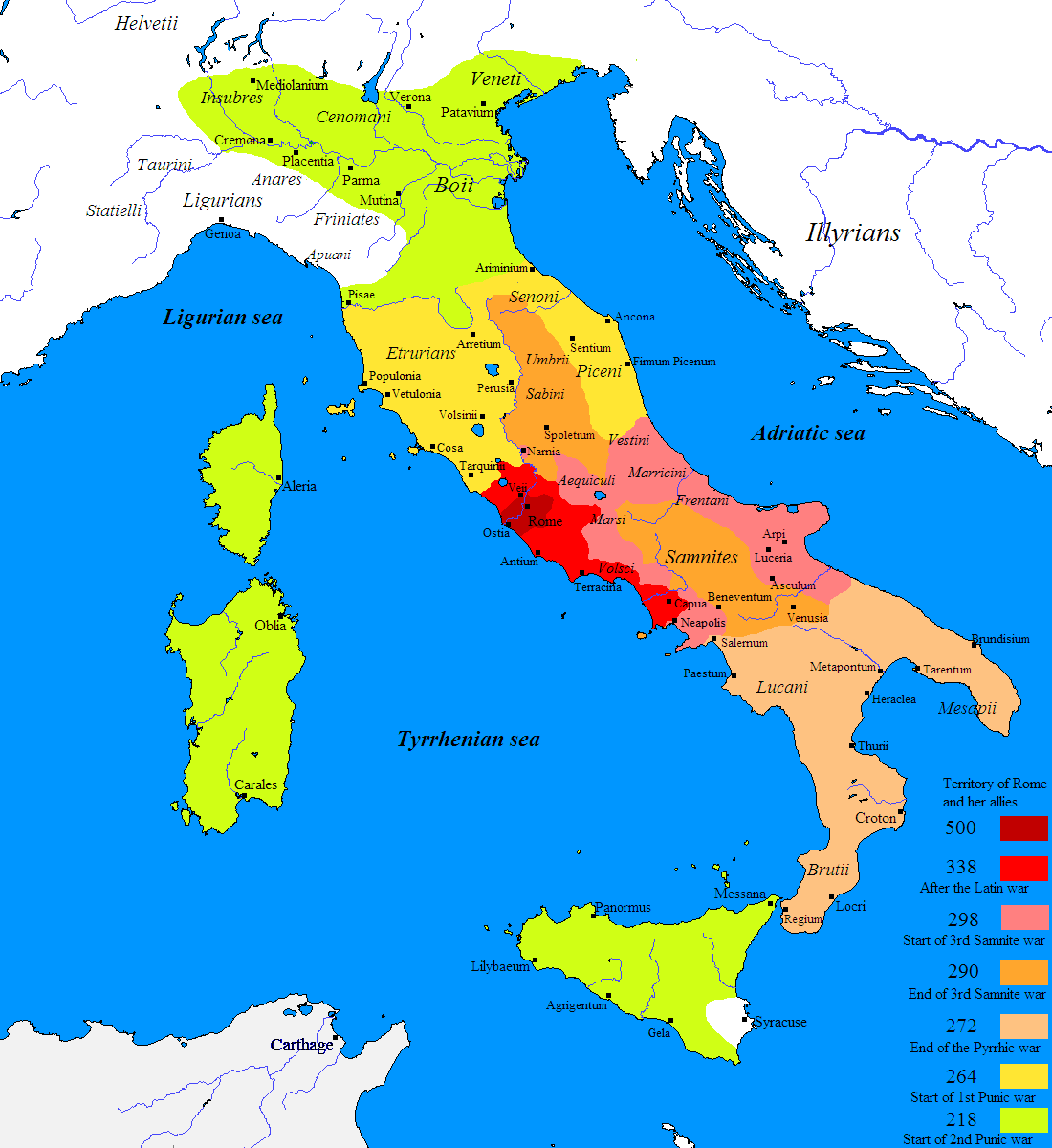
Roman Conquest of Italy

Book Ten Covers the period from 302 B.C. to 292 B.C. Generally know as the third Samnite war. Starts with the Aequi revolting and being crushed, followed by the invasion of a small town in the east by Spartan Greeks, who were beaten quickly and driven back to their ships. The Marsi were also put down, and so were the Etruscans again. Finally, on suspicious grounds, the Romans decided to war again with the Samnites. In 296 B.C., the Romans faced the combined forces of the Etruscans, Samnites, Umbrians and Gauls- it seems that the Romans were on a rampage, and they were generally feared by all in Italy. Again in battle, both Samnites and Gauls were fierce, but lacked technique, and were defeated in long, pitched battles. Livy says that the Romans defeated combined armies of 600,000 infantry and 45,000 horse, but implies that these numbers may not be reliable. After more skirmishes (where many thousands more fell), the Samnite armies were wiped out, and the Romans were left to besiege their cities.

After this book, presumably Livy covers the final Roman dominance over the whole of Italy, but Books 11 thru 20 are lost to history. Fortunately, others covered this period.

This book was very similar in style to the first, and to be fair, the arrangements of books are a function of the translation, so the similarity is no surprise. I still really liked this subject matter, so I had to give it 4 stars again...

4 starts out of 5 ****

Sunday, 21 February 2016

Livy: The Early History of Rome

Since I recently reported on a book that I read about ancient Roman history, that I did not find interesting, I thought I'd report on one that I really liked. I actually read this many years ago, but made notes in the margins to help my (very bad) memory. Anyway, here it is-

The Early History of Rome, Livy

A captivating, almost year-by-year account of the early history of Rome from about 1200 B.C. to 750 B.C. until about 385 B.C., summarized in five “books”. Spoilers ahead...
The city itself was founded sometime around 750 B.C. but the book starts long before that in an attempt to show (prove?) that the Romans (or more correctly, the Latins), originated from the Trojans of ancient Troy. That may or may not be true, and Livy settles quickly into a period of time during which Rome was ruled by kings, beginning with the story of Romulus and Remus -- one brother killing the other, and their city taking the name of Romulus.

Book One covers this period - from 750 B.C. (ish) to 507 B.C. Romulus was the first of seven kings, the last being Tarquin, who was ousted, the Romans tiring of being ruled by tyrants. With the election of the first Consuls, Brutus and Collatinus, the beginning of the Roman Republic was set in motion.

Book Two covers the time of the early republic - of wars with their neighbors, the Sabines, the Etruscans, Aurunci, Volscians, and more - and also of social change, particularly of friction between the patrician ruling class and the plebeian masses. Debtors were made slaves; creditors or lenders had the power of life and death over them. The plebs on the whole were indebted to the ruling class. The friction reached a climax where the plebs left the city of Rome in secession for an adjacent hilltop (the sacred mount) in 494 B.C. From here was born the concept of the Tribunes - representatives of the common people. With this crisis averted without bloodshed, the Romans refocused on fighting their neighbors. In this times, the Romans showed that they were capable of engaging in armed conflict on two fronts, simultaneously and separately engaging their rivals in Veii and the Aequians. By 480 B.C., Rome had arrived as a formidable military power. At the same time, the friction between plebeians and patricians continued - Consuls were put on trial by Tribunes at the end of their terms, and Tribunes were murdered.

Book Three covers the social upheaval in more detail, and covers the period from 467 B.C. to 446 B.C. It should be noted that Livy himself was a patrician, and outwardly criticizes the decisions and the actions of the Tribunes, and at times seems quite biased. There were patrician politicians who made concessions to the plebeians in the interest of better relations, but were often chastised by their own class. But there were advances and setbacks in the relationship. And focus often returned to external conflict- during this period, the Romans were at war again with the Aequians and the Henrici, and virtually wiped out the Volscians. (Apparently a cow talked in 461bc. o_0.) To help with their social problems, the Romans turned to the Greeks for advice, and sent envoys to study Greek law. A group of learned men were appointed - the Decemvirs (there were 10 of them) to temporarily replace the Consuls, and to publish laws that would govern Roman society. Consular and Tribunal positions were eliminated. This was a success to a certain extent, but the Decemvirs grew accustomed to their power, and the plebes, now without representation, were resentful. Again in 450 B.C., the entire plebeian population left Rome for the sacred mount; and again, there was no bloodshed. The crisis ended with the Consular and Tribunal positions reinstated.

Book Four covers the period from 455 to 404 B.C. This period stars with the Plebs requesting the right to elect one of the Consuls- a position strictly intended for patricians only, and was seen as a threat to the particians. But war got in the way again, and the Romans now faced renewed hostility from without, and to deal with it, the patricians in 444 B.C., allowed ‘Military Tribunes’ to hold Consular powers, to that Rome could get on with defending/attacking their external enemies. Famine and plague afflicted the city, and in 430 B.C., the Carthaginians landed in Sicily, but this was not seen as relevant at the time. Fighting continues against Veii, Aequians and Volscians.


Book Five covers the period from 403 B.C to 386 B.C., and this is when the rivalry between Rome and the Etruscan city of Veii came to a head. As the Romans laid siege upon Veii, armies of Capena and the Falerii attacked the Roman camps, however Roman preparedness and tactics resulted in the capture of the city, followed by the killing and enslaving of the entire population. At this time, Veii passes into history. For a century or more up to this time, the Celtic Gauls were gradually populating Etruscan territories in the Po valley and south of the Alps, and now they were on the move south. A Roman army met them, but Celtic victory was swift, and the Gauls proceeded to sack Rome. Livy says that the citadel remained intact and that the Romans paid a fortune in gold to persuade the Gauls to leave. He also says that a remnant Roman army surprised the Gauls outside Rome, and put them to slaughter. Some of these details are disputed, but the facts are that the Gauls came suddenly and were gone suddenly, and while Rome was vanquished, it remained, and after a generation, grew much, much stronger.

Unlike some of other Roman classic literature, I really enjoyed reading Livy. For the most part, he moves quickly from event to event, covering historical facts without too much bravado and embellishments. Well, for the most part, anyway. Aubrey De Selincourt's translation was easy to read, and Robert Oglivie's introduction was informative without being overly analytical.

**** 4 stars out of 5!


Monday, 1 February 2016

That's right, another book. Tacitus: The Annals of Imperial Rome

The Annals of Imperial Rome
Tacitus

One of my fave subjects is ancient history, and of that, ancient Roman history interests me the most. In this book, Publius Cornelius Tacitus, a Hadrian-era writer and senator, retells the stories of the Emperors from the death of Augustus to the downfall of Nero. Written sometime around AD 120, covering events from AD 14 to AD 66. Along with Suetonius, these works are the basis for our knowledge of the early Roman empire. Tacitus suggests that earlier authors were biased because of their being alive closer to or during the events, they wrote about, either in fear of retribution, or, more likely, in retaliation for poor treatment (personal or reputational injury) by the subjects of the text. I’m not sure who he was referring to- probably not Suetonius - he wrote after him - perhaps some lost works.

One interesting tidbit- Tacitus, a wealthy aristocrat, believed that the non-wealthy were all lazy. How things have not changed in 2000 years…

Tacitus describes Tiberius as aloof and absent from the Senate, and describes the climate in the Senate as one of predatory behavior - accusations of treason for the purposes of being awarded the property of the victims. He compares Tiberius’ adopted son, Germanicus, to Alexander the Great, showing an unexpected amount of love for a young warrior-politician. Maybe in the same way that Americans idolize JFK?

He doesn't say much about Caligula, whom he refers to as Gaius; most of these sections are lost. Much of the sections on Claudius were lost as well, although from what is left, we seems to shine a more favorable light on him. There is quite a lot of coverage on Nero, whom he portrays as quite a monster - especially after a failed coup by a group of senators, members of the guard and others. Paranoia seems to have played a major role in his spiral downward.

The drama of the political court is interesting when the players are generally known - for example, the emperors themselves, Germanicus, Sejanus, various well known senators, etc., but less interesting when the players are unknown (at least to me), and this tends to drone on and on.

I stalled on this years ago (2005?) near the end of the section on Tiberius. Later in 2015, I made it past that, and into the Claudius section, but faltered again. Finally finished with Claudius and the final sections on Nero in 2016. Again, a lot of court intrigue between unknowns (plus the fall of Neros’s mother Agrippina, which was far less interesting than I imagined that it would be).

For me, one of the ultimate goals was to read about Tacitus’ off-hand mention of a certain Christ executed by a certain Pilate, and how depraved these crazy Christ followers were. Just a small passage, but one of the few mentions in all ancient Roman works. Depravity is a term used often in Tacitus’ work; he uses it to describe the sexual perversions of Nero and others, but also Nero’s mere undignified habits as well - i.e., singing and acting. I guess ‘depravity’ can have many meanings. To be fair though, from other readings, it seems there was a lot of misinformation regarding Christians of the day (apparently, some Romans believed that they sacrificed their own children to their God, etc.).

I found myself questioning some the the prose in this book- having been written so many years after the events, and including minute details about people’s motivations, etc. While Tacitus did have access to senatorial records, did they really contain that much detail? I feel that much must have been hearsay at the very least, or perhaps even just made up. Now I know that many ancient authors, when writing about important events decades or centuries earlier, detailed long speeches made by relevant historical figures, and that they were just ‘capturing the mood of the moment’ in and around these events. But to me, at times it feels a little bit like fiction.

I’ve read both Suetonius and Tacitus covering the same period, and I definitely preferred Suetonius. Tacitus does bring a lot more detail, but for me, much of that extra detail wasn’t the interesting detail. I have ordered Tacitus’ “Histories” but won’t get to it for while. I don’t find Tacitus an easy read. I'd recommend it only to those with an extremely keen interest in the subject matter.

Saturday, 4 July 2015

A Guy Trip to NYC - phase 2

More on the May 2015 Guy trip to NYC with by buddies Pete and Fiz.
The Saturday started with a trip to the USS Intrepid museum on a large pier on the Hudson River just off the west side of Manhattan island (the Intrepid website).
Some background on the ship-
The USS Intrepid is an American aircraft carrier that was built during WW2, saw heavy action in 1943-1945, and continued to serve after the war. It originally looked like typical (but huge) WW2 aircraft carrier: USS Intrepid original configuration.
After modernization in the 1950's, it looked much different with a second angled flight deck, and could accommodate modern jet aircraft: USS Intrepid modernized config.
So my buddy Fiz and I went first thing Saturday morning to see this big behemoth - Pete "wasn't feeling well" and did not join us.
You've seen the outside in my previous post (NYC Guy Trip phase 1). So the first image is from the extreme front of the bow of the ship looking back along the flight deck:
The photo doesn't do justice to the immense size of this ship. The flight deck is crowded with all types of aircraft- some of which actually flew off the ship when it was in service, and some of which did not. If it were me designing the museum, I'd only allow aircraft that actually flew off the ship. But it's a museum, and they have to keep the locals coming back for more. I get it.
First airplane on the right is an SR-71 Blackbird:
Actually, it's a YF-12A, the "fighter" version, but it's basically the same thing. These definitely did not fly off carriers, but it sure is an impressive sight. These were the fastest airplanes ever built, but they are now retired. Their spying duties bettered by orbiting spy satellites, and their air-frames being old, they were no longer practical to keep flying. A shame, really.
Next in line was an F-16 Falcon (better known as "Vipers") - these never flew off carriers either - they're still in service in the US Air Force, and in other air forces all over the world.

And they are still very formidable fighters that can compete well against any modern fighter jet.
Next in line is an Israeli Kfir jet, also something that never flew off carriers..
These were used by the US Navy as adversarial aircraft for their dissimilar air combat training for their fighter pilots - as in Top Gun.
After that was an interesting US Navy helicopter, the H-19 Chicasaw:
It was a utility/search-and-rescue vehicle.
After that was a Bell H1J Sea Corba:
Sea Cobras were used by the US Marines, and were flown from carriers; not sure if they flew from Intrepid tho. They called the Cobra's main weapons system a "mini-gun" --
Looks pretty menacing to me...
Next in line was the venerable Twin Huey, UH-1, a machine that almost everyone flew - US Army, Air Force, Navy, Marines, and most allies around the world as well.
My dad flew these for the Canadian Army and the air force (when it was the Canadian Armed Forces).
Next in line was an AV-8B Harrier jump jet. These are US Marine jets that are still in use today, but will eventually be replaced by the F-35.
Harriers fly from carriers, but from special amphibious assault ships rather than fleet carriers like the old Intrepid.
That was the lineup on the right side of the forward flight deck (port side, actually).
Now, starting from the bow on the starboard side-
First is maybe the best fighter jet ever, is the F-14 Tomcat. I think I read that the Intrepid was actually too small(!) to fly F-14's... The star of the movie Top Gun, the F-14 is also the coolest jet ever, and gets 3 photos here; from the front:
Excellent view of the F-14's TV and infrared imaging systems, and how far back those variable-geometry wings sweep. You can see the F-14's lines better in the image below. This is actually a souped-up F-14, close the the standards of what was to become the "Super Tomcat" that never came about. This is evidenced by the larger than normal number of hard points - places to hang bombs.
The final image shows the business end of the F-14's big-ass engines. Not sure if this had those GE-F110-129 engines in there - probably not.
It was really cool seeing one of these bad boys up close!!
I think next in line was the A-6 Intruder, but for some reason I can't seem to find any photos. Oh well- you can see a bit of it beside the F-14, but not much of it- this ship definitely had A-6's aboard while at sea. After that was an F-11F Tiger:
The F-11 was a carrier fighter, and almost certainly flew off the Intrepid at one time (in the 1950's). Next in line was the F9F Cougar, which was pretty much an F-9F Panther with swept wings. The Panther was a beautiful airplane; the Cougar seemed like an after thought to me. However, the Cougar definitely flew off carriers, and probably off the Intrepid at some point (again, in the 1950's). Next to the Cougar was a Grumman E-1 Tracer-- it was the predecessor of the E-2C Hawkeye which still flies today. The E-1 is basically the same airplane, but with 1950's / 60's technology radar. 
The Intrepid definitely had one of these flying off her decks in the 50's and 60's - these were the eyes are ears of the fleet - they flew high, and spread their radar coverage for 100's of miles, allowing the fleet to react quickly to approaching enemy aircraft.
Beside the Tracer was the formidable F-4 Phantom fighter jet. This was the Navy's air-superiority fighter jet in the 60's and 70's. In it's day, it was the most powerful and feared fighter jet in the world. 
F-4 Phantoms flew from the decks of USS Intrepid until her last operational days...
Beside the F-4 was the F-3H Demon. This was a fighter plane that flew sometime before the F-4 did - in the early 1960's. I had no idea there were this big!
Don't know too much about the Demon, but the later F-4 Phantom does bears some minor resemblance - similar tail and slightly similar wings. I'm quite certain that Demons flew from the decks of Intrepid.
Next in line was an Italian trainer jet that didn't interest me.
I think that's all for now; I'll have more images soon from the decks of the mighty USS Intrepid; stay tuned!


Sunday, 1 March 2015

Another book: An Army at Dawn

An Army at Dawn

by Rick Atkinson

Traces the progress of the United States Army from just before Operation Torch (the invasion of German-controlled north Africa in late 1942 through to the destruction of the Axis forces in Tunisia in 1943.
The story begins with very detailed accounts of the invasion phase - at Oran, Algiers and Casablanca. Next is the first ineffective attempt at taking Tunis- if it was successful, it could have shortened the effort and suffering significantly. As it was, the attempt failed, and the Germans were permitted to bolster their forces for a longer, tougher fight. The story includes the arrival of the British 8th Army from the east, and the awkward interaction with the American efforts in the west. Despite Rommel's presence, the Allies eventually overwhelm the axis forces, and finally take Bizerte and Tunis.

In the book, there are some interesting details that are not well know by the layman. For example, French soldiers resisted the invasion with varying degrees of intensity- some very much so- and actually wore battle decorations for this resistance after changing sides in the conflict to fight the Germans and Italians along side the Americans and British. Many US officers (Patton, Bradley, etc.), did not trust the British, feeling that they were happier to see US casualties than their own. Similarly, British Generals (Montgomery, Alexander, etc.), though that US infantry were poorly trained and not very useful. Both were true to a certain extent, and this was one of the many aspects of the Alliance that Eisenhower had to manage. 

Interestingly, the Germans had their own leadership challenges- one in particular, when General Rommel chased the US Army up the Kasserine Pass- he may well have chased the Americans right out of Tunisia, and up to the coast in Algeria, had not his colleague, General Armin, taken half of his tank strength- for no good reason. That ended up being very good for the Allies, and very unfortunate for the Axis.

The book also contains some extremely vivid technical accounts - for example, you could actually watch the path of a German 88mm gun's anti-tank shell from afar by the sand and dust that it sucked up as it traversed the desert floor at head level, at over 2500 feet per second. The German tanks for the most part, out-classed the Allied tanks in terms of general design, armour and gun quality, forcing the Allies to rely on quantity over quality (which, fortunately, they could do). 

This book was very well researched, and contains loads of info about the all of the major (and many minor) events and all of the major (and many minor) characters. A good measure of a military book is the quantity and quality of the maps accompanying the text; the maps in this book were some of the best I've ever seen. The work was very well done, and is highly readable. Highly recommended to the history buff, or even those with casual interest.


Tuesday, 27 January 2015

Another book: HMS Hood


The Battlecruiser HMS Hood, an Illustrated Biography

Bruce Taylor

It’s a coffee table book, I guess, but it’s filled with information and images if the late great British Battlecruiser HMS Hood.

I've always been fascinated by large fighting ships- their grandeur, power and grace- and the roles that they played in major conflicts in the 20th century. Later, I became obsessed with the idea that a ship with hundreds of persons on board - a virtual floating city- could be destroyed and sunk - with all those people in a matter minutes. Where were they when they perished? Why couldn't they get out? This book answered many questions for me.

HMS Hood started life as a ship among ships- more modern, more glorious, more everything than any other ship in any other navy. She had 15 inch guns, was capable of well over 30 knots and carried her officers and crew in more comfort that any fighting ship before her. She was the biggest ship ever built for the Royal Navy.

HMS Hood on its World Tour, Melbourne, Australia, 1924 


HMS Hood leaving Hawaii on its world tour, 1924


HMS Hood was designed by the same people that designed the original WW1 battlecruisers that played a major role at the battle of Jutland-- and paid a heavy price. Designed to arrive fast, fight at close range, escape and repeat, they were at great disadvantage fighting it out at long range against battleships. The British were aware of this disadvantage in WW1, and were no less aware of it in 1941. Her range-finding equipment was inferior to the equipment used by the most modern fighting ships, and she used a more volatile gun propellant than the Germans or Americans did in WW2. All these facts would play a role in her fate.

Left: The Torpedoman's mess-deck. Right: The Officer's Wardroom


The Torpedomen crew ate, lived and slept in their mess (there were several). They ate at those tables, then slept above them in hammocks- in very close quarters. This is from 1931. Officers ate and drank in the Officer's Wardroom. They had separate quarters for sleeping. This is from 1932.

The lifetime of HMS Hood closely reflects the decline of the Royal Navy. In the 1920s, Britannia ruled the waves, and the Hood was the star of a Royal Navy world tour that circumnavigated the globe. It was the apex of her glory- she was the biggest, fastest, most powerful ship in the world. But there was much change over her 20+ years- she changed over time, as did the world- and she couldn't keep up.
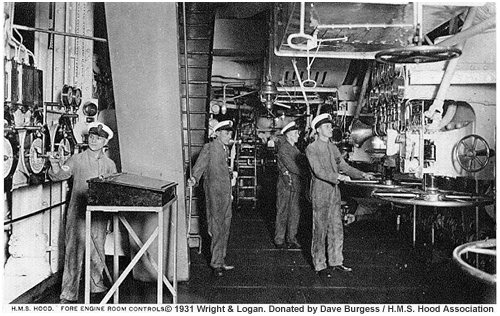
Engine room throttle action in the Hood, 1931

By the 1930s, the Hood (like the Royal Navy) was still highly revered and magnificent outwardly, but old, rusty and rotten inside. Constant leaking promoted rusting of bulkheads and machinery, and hampered the efficiency and integrity of her fresh water systems. Training was neglected. She was also a major player in the sad story of the Invergordon mutiny- caused by a shameful rift between the officer and crew classes in the RN.

Years of neglect wore on her. By the late 1930s, she was weighted down by the weight of many layers of paint (tons), tons of new equipment; she rode low in the water and she still leaked constantly. Training was improved, but the ship was aging. There were newer ships in the RN, and many more modern ships in several navies of the world. She was still the pride of the Royal Navy, but her sad fate awaited her.


The Hood's stoker crews, May 1941.
Most of these men went down with the ship;
many died at the same moment, just after 6AM on May 24, 1941.


WW2 came quickly, and planned improvements would have to wait. Like the Royal Navy, she had been rushed into service, somewhat unprepared, but fought gallantly. In the end, her demise punctuated the decline of the Royal Navy. In 1941, she was sunk by the Battleship Bismarck, a brand new German battleship, the Hood being well over 20 years in service at that time.


The last view of the once Mighty Hood, May 24, 1941.
The ship and her crew of almost 1500 were gone within 3 minutes.


All these images are from the book, and can be found all over the web. The book also contains some wonderful cut-away views and schematics. But more that that, the full story of the Mighty Hood from start to finish is contained within this book.

I enjoyed this book enormously, and would recommend it to any history or navy enthusiast.

Thursday, 1 August 2013

Another book: Winston Churchill: Young Statesman

Here's another one:

Young Statesman- Winston Churchill 1901-1914
R. Churchill

This book covers the life of Winston Churchill after his military experiences in India and Africa. He started as a member of the Conservative party, running in a “safe seat” guaranteeing election, but soon became disenchanted with the protectionist leanings of the party. He then "crossed the floor" and became a member of the Liberal party. Whether he really felt this way, or he saw it as an opportunity as the Conservative party crumbled around him is anyone’s guess. He did however, very effectively champion the concept of free trade. Either way, it was obvious that he had a great talent for both writing speeches and for delivering them. The book contains a plethora of examples of both. He was clearly seen as a very capable and rising star in politics by those who mattered-- members of parliament (both Conservative and Liberal), the press, and the influential, aristocratic and privileged classes. He was also a bit of a visionary; as early as 1904, he recognized the importance, and even the inevitable future involvement of the United States in European affairs.

By 1906 he became Under Secretary for the Colonies,, and was in the Privy Council a year later. In the same year, he first used the phrase “terminological inexactitudes” to indicate inaccurate terminology, but soon the phrase was understood to be a polite term for lying.
In 1906 he went for a “working holiday” - much of it personal time, and used the Royal Navy cruiser HMS Venus as his transportation. In modern times, this would seem an outrageous misuse of Navy resources, but was an accepted perk in the early 1900s, for a colonial official working for the government of a world power, in a time without air travel.

After making it to the Cabinet, he had to face an election- was defeated, then won again in a “safe” Liberal seat. In this election, he differentiated Liberalism and Socialism in this way: “Socialism wants to pull down wealth; Liberalism wants to pull up poverty...” a stance that stands up well more than 100 years later, even as the terms “Liberal” and “Socialist” have changed slightly in that time.

He was described by David Lloyd George, future Prime Minister (and longtime friend of Churchill), as being “as long winded as he is persistent” - this was a fair statement, and defined Churchill well, which is punctuated time and time again throughout his public career.

He was soon made a member of Asquith's cabinet, and ran the Home Office, where he initiated positive advancements for unions and the poor. He was also instrumental in attempts to advance the Irish Home Rule bill, and was not popular with Ulster for his efforts. He then advanced to the top spot in the Admiralty, as "First Lord" - the top political post in control of the Royal Navy, where his energy, intelligence and communication skills got him off to a great start, and did the country well in preparing for the inevitable clash with Germany. 

There’s a lot of information in these books -- a lot. If you have a keen interest in Winston Churchill, the build-up to the Great War, or British politics of this era, this is a very interesting book, and a good source of information. If you’re casually interested, look for a thinner book...


Saturday, 2 March 2013

And another one: The Red Badge of Courage


The Red Badge of Courage

S. Crane

An American classic containing vivid, violent and realistic fighting scenes from the Civil War. Stories of war from the perspective of the regular private grunt intrigue me the most- it's not about an officer's opinions, relaying of facts and summations about large events, but rather the helplessness and confusion of the every-day man put into a place where no man would want to be. The scenes of battle ring so true in Red Badge of Courage, that book reviewers of the day assumed that the author was writing from his own personal battlefield experiences. He was not. He did not fight in the war, and he never saw battle until after he wrote the book, and even then it was as an observer (he wanted to see first hand if his book held up to the real thing- it did).
But the book is not really about the war at all- it is a backdrop for the story of a youth's internal struggle between his natural fear, cowardice and need to flee, and his deep desire to conceal his fear. Fear of being labelled and ridiculed by his peers as a coward and a deserter. In the thick of his first battle, he does just that- he is overcome by the fear of being overrun and killed, and desperately wants to run for his life, and finally, as a few others begin to flee, he joins them in a mad rush away from the charging enemy. After, in his internal deliberations he makes up excuses, makes rationalizations, transfers of admonishments to others, and outright alters the facts to avoid having to face his own cowardice. Eventually he makes his way back to his unit, and forces himself to stay, engage in battle, and to finally redeem himself (and more).
I think the book was so popular because it portrays the reaction that everyman would have to the ferocity of battle. Sure, there are people who were born to fight, and those who crave battle for the experience, but most people want to live their lives in peace and safety, and to pursue happiness, as it were. This is most people. His internalizations reflect those of the many- those normal ones that, when it is thrust upon them,  see war as an unspeakable horror, and not as a game or an adventure.
Most men would say outwardly that "I would never run" and it may be true of many, but for many more, what happens to the poor youth, Henry Fleming is what the rest of us fear, deep down inside. That our fear and cowardice will be discovered by all.
Written in the 1890's, the dialogue (probably) reflects the colloquial speak of the day, yet it is easy to read, the prose flowing and well written. Highly recommended for both those interested in the American classics, and for those interested in the Civil War.

Saturday, 7 April 2012

Vietnam :== Aghanistan

I watched this show on History Channel recently (http://www.history.ca/ontv/titledetails.aspx?titleid=280849). 
What began as the US trying to prevent the North from overrunning the South in Vietnam turned into something completely different. As the North infiltrated the South, the US troops couldn’t tell the difference between infiltrators and the people they were ostensibly there to help. Gradually, you couldn’t tell the civilians from the enemy. And eventually, many of the civilians actually became the enemy. Sounds familiar?
This is the same problem that the US, UK and Canada were having / are still having in Afghanistan. Once this happens, the mission has changed. The original mission doesn’t exist anymore. If you’re still pushing the original mission, you have no chance of success. The result will be the same as Vietnam- a lost war (unless you plan to stay forever, and that can’t happen). The Taliban will not go away, and will prevail weeks after you quit the situation.
So can the situation be salvaged? If so, what is the new mission? Escalation? Total war? What would have worked in Vietnam? Difficult question. 
Unfortunately, the parallels are too close to ignore.
Depressing.