Growing up as a kid, nobody ever taught me to throw a baseball. I just learned by trial and error. In fact, everything I knew about baseball up until I was over 40, was learned by observation and trial and error. Well, there was the time when I asked Bob Allisat how to hit a fast pitch, and he told me to keep my feet together and step into the pitch as the pitcher threw the ball. He was mostly right, and it helped a lot. That's about it, though.
I learned from watching friends, and watching baseball on TV. I did have a certain amount of natural ability - I was a fast runner, which helped me overcome my many mistakes in fielding and my lack of knowledge of positioning. But I learned these things too, by watching friends, competitors and the Montreal Expos. Watching pro outfielders (especially Andre the Hawk Dawson, perhaps my fave player ever) cured me of throwing side-arm from the outfield. Watching other fielders taught me to communicate verbally with other fielders while tracking down fly balls and grounders.
But I didn't really understand the game until I was over 40 and started coaching my own kids (and other people's kids). At first, I was an assistant coach, and learned a heck of a lot from John, Warren, Pat and Rob. After two years, I could teach stuff that I didn't know two years earlier. Tons of stuff. Being strictly an outfielder, I knew very little about the infield. In fact, I had no idea how to play any of the positions. Not really. Two years later, I could teach them. The most important thing I learned was the "ready position" - that's 50% of it right there. Knowing what to do THAT PLAY, based on the number of outs, and where the base runners are. That's another 25% right there. 75% of the way to being a good infielder right off the bat (pun intended).
I then watched pitching coaches teach pitching to my kids - and learned a lot from both Dave and Warren. A whole lot. Now I can take a kid, show him a few things, and turn him into a pitcher. At least a relief pitcher. (Assuming he has some basic throwing skills already- which is not always the case.) Which takes me to throwing a ball.
As I said, I had some natural ability, a strong arm and some not totally bad technique. (Stopped throwing side-arm before high school.) There's more throwing than a strong arm, though. In fact, while arm strength is 50% of it, technique is everything else. You use your whole body - including your legs - to throw a ball. I see youth pitchers using only their arms, and doing well. I can only imagine how much better they could do if they would just use some proper technique. Eric, I'm talking to you.
Now have a look at this picture. This is Nomar Garciaparra, who was a big star shortstop for the Boston Red Sox in the 1990s and early 2000s. Here, with the Cubs, while tossing the ball in the infield, he shows us one of the most important aspects of throwing a ball. A proper wind up. I'm not talking about the complicated pitcher's windup like in the way cool image below, but rather just a simple start to a basic throw. Like tossing the ball from shortstop to first base between innings, warming up before the game, tossing a ball with a pal, etc.
Football guys will do something similar, but will cradle that ball (like it was a football) with hand facing upwards. Incorrect for baseball. An extended arm with the hand (and ball) facing down is the correct way to start your throwing motion. Many good athletes can throw just fine (results-wise) not doing this. But like anything else, using proper technique will improve your game no matter how well you're doing with improper technique. If you're throwing accurately 90% of the time with poor technique, you'll get closer to 100% using proper technique.
More importantly though, a kid throwing accurately 50% of the time or less, using improper technique, will dramatically improve accuracy (and velocity) using proper technique. If you're not starting your throwing motion like that, do it, and see the difference. And even more importantly, get your kid to start his throwing motion like this. It matters, and it will definitely make a difference.
Showing posts with label Sports. Show all posts
Thursday, 21 July 2016
Monday, 2 February 2015
Trophy Presentations to Championship Teams
Watched the Superbowl on the weekend, and something occurred to me about the presentation of the trophy to the winning team.
The National Hockey League (NHL) does it right. The National Football League (NFL) and Major League Baseball do it wrong.
The NHL Crowning Event
The National Hockey League (NHL) does it right. The National Football League (NFL) and Major League Baseball do it wrong.
The NHL Crowning Event
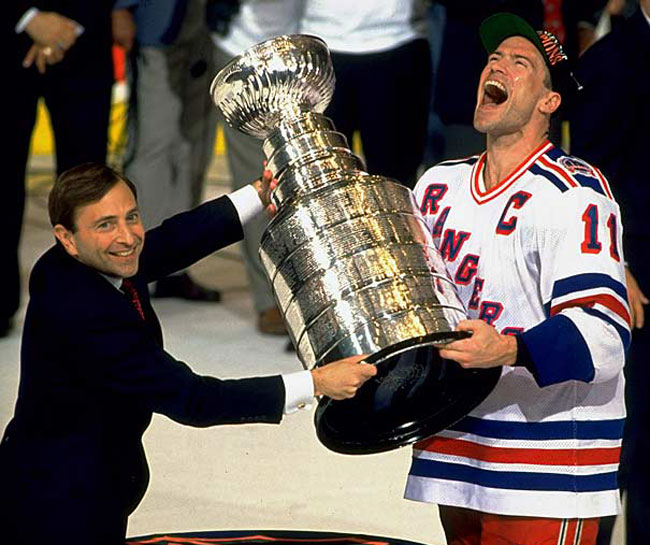
When the NHL crowns its champion, the league president says very little, and presents the championship trophy to the players- specifically, to the winning team's player captain. The celebration begins immediately- the people that matter- players and fans are center stage. The old fart team owners and executives and the league president and executives are not an integral part of the celebration.
Here's what is looks like when the NHL does it:
Hmmmm. Not the same thing, really, is it? Bill Belichick looks not sad. Patriots owner Robert Craft looks rich. And how do the players feel about this moment? I guess that's not really important.
The MLB black suit Event
The NFL black suit Event
The NFL gives us a mini state of the union speech from the hated league president, followed by presentation of the trophy to an old sod of a rich guy in a suit. The old owner in a suit then makes his speech for a while. Meanwhile, the people that matter, the players and the fans, stand around until the suits have their glory orgy. Nobody wants to see the president hand the trophy to an old guy in a suit. Nobody has tears in their eyes thinking about how much money that poor owner had to spend to buy a championship. Nobody reflects upon what that rich guy in a suit must have been going through watching that game from his luxury suite.
Here's what it looks like when the NFL does it:
Hmmmm. Not the same thing, really, is it? Bill Belichick looks not sad. Patriots owner Robert Craft looks rich. And how do the players feel about this moment? I guess that's not really important.
The MLB black suit Event
Major League Baseball gives us little more- the only plus is that the baseball owners are usually a bit older, the trophy is more fragile-looking, and there's always the chance that the old guy in the suit might drop the thing, or drop dead on top of it.
Here's what it looks like when Major League Baseball does it:
Ummmm. What team won? Well, it says 2013 World Series, so I guess it's the Red Sox. John Farrell (far right, not near the trophy) looks not sad. I think some of those other people in black suits played a major role in beating the Cardinals that day. I guess.
The point?
The NFL and Major League Baseball need to have a look at how the NHL does it, and take a lesson. The best presentation. For the players. For the fans. No one else matters here. Nobody cares what people in black suits have to say after a championship game. For the most part, nobody even cares who they are, or if they were even there. Really, you guys; nobody.
The point?
The NFL and Major League Baseball need to have a look at how the NHL does it, and take a lesson. The best presentation. For the players. For the fans. No one else matters here. Nobody cares what people in black suits have to say after a championship game. For the most part, nobody even cares who they are, or if they were even there. Really, you guys; nobody.
Thursday, 13 June 2013
Baseball stats- ya gotta love 'em!
One of the many things I love about baseball is the stats. It starts with a pitcher's number of wins, losses, games started, games completed, shutouts, strikeouts, walks allowed, and ERA (run average per nine innings of pitching not including those runs scored due to defensive errors), and much more. And there's players fielding percentages- the number of errors compared to the total number of times the player fielded the ball. And then there's the batters hitting stats- number of hits, number of doubles, number of triples, number of home runs, number of runs scored, number of walks, batting average, on-base average, slugging percentage, and much more.
Then there's the story of my poor Montreal Expos, who one year decided to improve their offence at the expense of defense. At the end of the year, they were the top team in their division in pitching (measured by pitcher's ERA, strikeouts, and other stats), and they were the top team in their division in hitting (measured by batter's batting average, runs scored and other stats). That year, they finished third in their division, because they used the better-hitting Wallace Johnson at second base instead of defensively amazing (but anemic hitting) Rodney Scott. Their preference for offensive numbers ahead of the less-measureable defensive capabilities was their downfall.
Then there's the story of the movie MoneyBall, and the real-life exploits of the Oakland A's in the early 1990s and the Boston Redsox on the early 2000s- proving that focusing on some statistics- the more important ones- does deliver results.
I bring all this up because I just read this article: http://www.athleticsnation.com/2013/6/12/4419388/bartolo-colons-historic-season. It's about the A's Bartolo Colon, who is having a good season pitching, while walking very few batters. And to quantify Colon's season, the author has dug deeply into the data (big data) to find the player's walks per nine innings of pitching and to calculate the player's walk percentage of total batters faced. But not just that-- also, the percentage of pitches in the strike zone, as called by the umpires, and of course, the percentage of pitches in the strike zone, as determined by Pitch f/x (which tracks the number of pitches that a pitcher throws both in and out of the strike zone, no matter what the umpires actually call the pitch).
So what does this all mean in the greater scheme of things?
Almost nothing.
But it makes me love baseball even more!
Then there's the story of my poor Montreal Expos, who one year decided to improve their offence at the expense of defense. At the end of the year, they were the top team in their division in pitching (measured by pitcher's ERA, strikeouts, and other stats), and they were the top team in their division in hitting (measured by batter's batting average, runs scored and other stats). That year, they finished third in their division, because they used the better-hitting Wallace Johnson at second base instead of defensively amazing (but anemic hitting) Rodney Scott. Their preference for offensive numbers ahead of the less-measureable defensive capabilities was their downfall.Then there's the story of the movie MoneyBall, and the real-life exploits of the Oakland A's in the early 1990s and the Boston Redsox on the early 2000s- proving that focusing on some statistics- the more important ones- does deliver results.
I bring all this up because I just read this article: http://www.athleticsnation.com/2013/6/12/4419388/bartolo-colons-historic-season. It's about the A's Bartolo Colon, who is having a good season pitching, while walking very few batters. And to quantify Colon's season, the author has dug deeply into the data (big data) to find the player's walks per nine innings of pitching and to calculate the player's walk percentage of total batters faced. But not just that-- also, the percentage of pitches in the strike zone, as called by the umpires, and of course, the percentage of pitches in the strike zone, as determined by Pitch f/x (which tracks the number of pitches that a pitcher throws both in and out of the strike zone, no matter what the umpires actually call the pitch).
So what does this all mean in the greater scheme of things?
Almost nothing.
But it makes me love baseball even more!
Sunday, 2 June 2013
How to catch a football
Just wanted to present the most awesome photo of a football catch I have ever seen. The man's name is JJ Stokes. He was a decent receiver, not a great one; he played on the San Francisco 49ers when Terrell Owens was becoming a huge star...
No, it doesn't look like much, but what it does show is the super-intense concentration it takes to make a catch- even a seemingly simple catch. Hands ready and spread wide, eyes wide open and focused on the ball. Turning the body as much as possible towards the ball. That's what you have to do.
It's true that some players make 100 or more catches in a single year, so how hard can it be? Well, on the NFL broadcasts every Sunday (and Monday and Thursday, and sometimes Saturday), you're watching the best players in the world catch footballs. The truth is, the 3rd and 4th string receivers on most teams drop the ball a lot. Semi-pro receivers drop even more passes. Even the great Terrell Owens dropped tons of balls in his last couple of years.
The most common reason for dropping a passed ball is that the receiver just can't do it well. But those that do it well drop balls, too-- they take their eyes off the ball early. And that's the second most common reason for dropping the ball. A receiver will sometimes think too far ahead of the catch: "now that I'm about to catch this ball for sure, what will be my next move? where will I run? where is the nearest tackler? where are my blockers? where is....oops..."
The problem was right at the start- taking the eye off the ball.
And that's why I love this photo. Stokes shows us what you have to do-- what the best in the world have to do:
KEEP YOUR EYE ON THE BALL !!
No, it doesn't look like much, but what it does show is the super-intense concentration it takes to make a catch- even a seemingly simple catch. Hands ready and spread wide, eyes wide open and focused on the ball. Turning the body as much as possible towards the ball. That's what you have to do.
It's true that some players make 100 or more catches in a single year, so how hard can it be? Well, on the NFL broadcasts every Sunday (and Monday and Thursday, and sometimes Saturday), you're watching the best players in the world catch footballs. The truth is, the 3rd and 4th string receivers on most teams drop the ball a lot. Semi-pro receivers drop even more passes. Even the great Terrell Owens dropped tons of balls in his last couple of years.
The most common reason for dropping a passed ball is that the receiver just can't do it well. But those that do it well drop balls, too-- they take their eyes off the ball early. And that's the second most common reason for dropping the ball. A receiver will sometimes think too far ahead of the catch: "now that I'm about to catch this ball for sure, what will be my next move? where will I run? where is the nearest tackler? where are my blockers? where is....oops..."
The problem was right at the start- taking the eye off the ball.
And that's why I love this photo. Stokes shows us what you have to do-- what the best in the world have to do:
KEEP YOUR EYE ON THE BALL !!
Monday, 4 March 2013
Vince Carter: bench strength
![]() |
| Vince Carter |
![]() |
| Charles Oakley |
Now he's bench strength - probably a fitting ending to a fantastic career that almost was. With a career filled with little more than highlight reel moments, he may make it to the hall of fame when he retires, but soon after that he will be forgotten. You see, only leaders and winners are remembered.
Wednesday, 9 November 2011
Penn State football scandal
I’m no longer a Penn State football fan, and maybe I’m also done with college football altogether. With the scandal at hand (http://bit.ly/t4RD3u), I no longer feel the affinity that I have enjoyed for some 20+ years. I’ve been to four games in State College PA (one during my honeymoon!), enjoyed the pre-game tail-gate festivities and the post-game wind-downs. I’ve made friends there, and I loved going there. Plans were underway to look at going again on a future anniversary. Not now though, I’m done with it.
I feel bad for coach Joe Paterno, aka Pappa Joe, I suppose, in a way. I guess if he was informed of a serious allegation, but refused to believe it, and thought nothing of it again, well, that’s the best light I can shine on him, and it’s not that good. If he and others were fully aware of what went on there for almost 20 years, then it is a crying shame, not to mention a crime.
There are stories of people aware of wrong-doings, but were unwilling to blow the whistle for fear of losing their jobs. Hmmmm. If you blow the whistle, and lose your job because of it, maybe you have to sell your house and move away. That’s not a good balance sheet, but at least on the plus side, you can look at yourself in the mirror and know that you did the right thing. On the other hand, if you know that a crime has been committed, and do nothing, you maybe save your job, but you can’t look at yourself in the mirror. You saw evil, you could have done something about it, you did nothing. That’s not a good balance sheet either. And then if the world finds out that you knew, and did nothing, well....
The rally in front of Papa Joe’s house yesterday might have been heart-warming under most any other circumstance. Normally, the vision of a college campus rallying to support their heroes is enough to bring tears to my eyes. Well, the tears are there, but for a different reason. The time to rally the cause is past. The time to rally was when the first allegations came out. That was the time to investigate, and to ensure that the truth was exposed. A second allegation was the time to slam on the breaks and ask “what the hell is going on here!?!”
I think that they need to shut the football programme down right now. Think about it- other football programmes have been shut down for things like requiting violations. For allegations of bribery and betting, and payments under the table to players and students. Guys, this is worse than all these things put together!!
Worried about the reputation of the Penn State football programme? Well, I got news for you guys, it ain’t “Linebacker U” anymore. Now and for the future, it’s “Pedophilia U...”
I’m out.
I feel bad for coach Joe Paterno, aka Pappa Joe, I suppose, in a way. I guess if he was informed of a serious allegation, but refused to believe it, and thought nothing of it again, well, that’s the best light I can shine on him, and it’s not that good. If he and others were fully aware of what went on there for almost 20 years, then it is a crying shame, not to mention a crime.
There are stories of people aware of wrong-doings, but were unwilling to blow the whistle for fear of losing their jobs. Hmmmm. If you blow the whistle, and lose your job because of it, maybe you have to sell your house and move away. That’s not a good balance sheet, but at least on the plus side, you can look at yourself in the mirror and know that you did the right thing. On the other hand, if you know that a crime has been committed, and do nothing, you maybe save your job, but you can’t look at yourself in the mirror. You saw evil, you could have done something about it, you did nothing. That’s not a good balance sheet either. And then if the world finds out that you knew, and did nothing, well....
The rally in front of Papa Joe’s house yesterday might have been heart-warming under most any other circumstance. Normally, the vision of a college campus rallying to support their heroes is enough to bring tears to my eyes. Well, the tears are there, but for a different reason. The time to rally the cause is past. The time to rally was when the first allegations came out. That was the time to investigate, and to ensure that the truth was exposed. A second allegation was the time to slam on the breaks and ask “what the hell is going on here!?!”
I think that they need to shut the football programme down right now. Think about it- other football programmes have been shut down for things like requiting violations. For allegations of bribery and betting, and payments under the table to players and students. Guys, this is worse than all these things put together!!
Worried about the reputation of the Penn State football programme? Well, I got news for you guys, it ain’t “Linebacker U” anymore. Now and for the future, it’s “Pedophilia U...”
I’m out.
Subscribe to:
Posts (Atom)