Sunday, 21 February 2016

Livy: The Early History of Rome

Since I recently reported on a book that I read about ancient Roman history, that I did not find interesting, I thought I'd report on one that I really liked. I actually read this many years ago, but made notes in the margins to help my (very bad) memory. Anyway, here it is-

The Early History of Rome, Livy

A captivating, almost year-by-year account of the early history of Rome from about 1200 B.C. to 750 B.C. until about 385 B.C., summarized in five “books”. Spoilers ahead...
The city itself was founded sometime around 750 B.C. but the book starts long before that in an attempt to show (prove?) that the Romans (or more correctly, the Latins), originated from the Trojans of ancient Troy. That may or may not be true, and Livy settles quickly into a period of time during which Rome was ruled by kings, beginning with the story of Romulus and Remus -- one brother killing the other, and their city taking the name of Romulus.

Book One covers this period - from 750 B.C. (ish) to 507 B.C. Romulus was the first of seven kings, the last being Tarquin, who was ousted, the Romans tiring of being ruled by tyrants. With the election of the first Consuls, Brutus and Collatinus, the beginning of the Roman Republic was set in motion.

Book Two covers the time of the early republic - of wars with their neighbors, the Sabines, the Etruscans, Aurunci, Volscians, and more - and also of social change, particularly of friction between the patrician ruling class and the plebeian masses. Debtors were made slaves; creditors or lenders had the power of life and death over them. The plebs on the whole were indebted to the ruling class. The friction reached a climax where the plebs left the city of Rome in secession for an adjacent hilltop (the sacred mount) in 494 B.C. From here was born the concept of the Tribunes - representatives of the common people. With this crisis averted without bloodshed, the Romans refocused on fighting their neighbors. In this times, the Romans showed that they were capable of engaging in armed conflict on two fronts, simultaneously and separately engaging their rivals in Veii and the Aequians. By 480 B.C., Rome had arrived as a formidable military power. At the same time, the friction between plebeians and patricians continued - Consuls were put on trial by Tribunes at the end of their terms, and Tribunes were murdered.

Book Three covers the social upheaval in more detail, and covers the period from 467 B.C. to 446 B.C. It should be noted that Livy himself was a patrician, and outwardly criticizes the decisions and the actions of the Tribunes, and at times seems quite biased. There were patrician politicians who made concessions to the plebeians in the interest of better relations, but were often chastised by their own class. But there were advances and setbacks in the relationship. And focus often returned to external conflict- during this period, the Romans were at war again with the Aequians and the Henrici, and virtually wiped out the Volscians. (Apparently a cow talked in 461bc. o_0.) To help with their social problems, the Romans turned to the Greeks for advice, and sent envoys to study Greek law. A group of learned men were appointed - the Decemvirs (there were 10 of them) to temporarily replace the Consuls, and to publish laws that would govern Roman society. Consular and Tribunal positions were eliminated. This was a success to a certain extent, but the Decemvirs grew accustomed to their power, and the plebes, now without representation, were resentful. Again in 450 B.C., the entire plebeian population left Rome for the sacred mount; and again, there was no bloodshed. The crisis ended with the Consular and Tribunal positions reinstated.
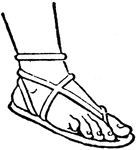
Book Four covers the period from 455 to 404 B.C. This period stars with the Plebs requesting the right to elect one of the Consuls- a position strictly intended for patricians only, and was seen as a threat to the particians. But war got in the way again, and the Romans now faced renewed hostility from without, and to deal with it, the patricians in 444 B.C., allowed ‘Military Tribunes’ to hold Consular powers, to that Rome could get on with defending/attacking their external enemies. Famine and plague afflicted the city, and in 430 B.C., the Carthaginians landed in Sicily, but this was not seen as relevant at the time. Fighting continues against Veii, Aequians and Volscians.


Book Five covers the period from 403 B.C to 386 B.C., and this is when the rivalry between Rome and the Etruscan city of Veii came to a head. As the Romans laid siege upon Veii, armies of Capena and the Falerii attacked the Roman camps, however Roman preparedness and tactics resulted in the capture of the city, followed by the killing and enslaving of the entire population. At this time, Veii passes into history. For a century or more up to this time, the Celtic Gauls were gradually populating Etruscan territories in the Po valley and south of the Alps, and now they were on the move south. A Roman army met them, but Celtic victory was swift, and the Gauls proceeded to sack Rome. Livy says that the citadel remained intact and that the Romans paid a fortune in gold to persuade the Gauls to leave. He also says that a remnant Roman army surprised the Gauls outside Rome, and put them to slaughter. Some of these details are disputed, but the facts are that the Gauls came suddenly and were gone suddenly, and while Rome was vanquished, it remained, and after a generation, grew much, much stronger.

Unlike some of other Roman classic literature, I really enjoyed reading Livy. For the most part, he moves quickly from event to event, covering historical facts without too much bravado and embellishments. Well, for the most part, anyway. Aubrey De Selincourt's translation was easy to read, and Robert Oglivie's introduction was informative without being overly analytical.

**** 4 stars out of 5!


Monday, 1 February 2016

That's right, another book. Tacitus: The Annals of Imperial Rome

The Annals of Imperial Rome
Tacitus

One of my fave subjects is ancient history, and of that, ancient Roman history interests me the most. In this book, Publius Cornelius Tacitus, a Hadrian-era writer and senator, retells the stories of the Emperors from the death of Augustus to the downfall of Nero. Written sometime around AD 120, covering events from AD 14 to AD 66. Along with Suetonius, these works are the basis for our knowledge of the early Roman empire. Tacitus suggests that earlier authors were biased because of their being alive closer to or during the events, they wrote about, either in fear of retribution, or, more likely, in retaliation for poor treatment (personal or reputational injury) by the subjects of the text. I’m not sure who he was referring to- probably not Suetonius - he wrote after him - perhaps some lost works.

One interesting tidbit- Tacitus, a wealthy aristocrat, believed that the non-wealthy were all lazy. How things have not changed in 2000 years…

Tacitus describes Tiberius as aloof and absent from the Senate, and describes the climate in the Senate as one of predatory behavior - accusations of treason for the purposes of being awarded the property of the victims. He compares Tiberius’ adopted son, Germanicus, to Alexander the Great, showing an unexpected amount of love for a young warrior-politician. Maybe in the same way that Americans idolize JFK?

He doesn't say much about Caligula, whom he refers to as Gaius; most of these sections are lost. Much of the sections on Claudius were lost as well, although from what is left, we seems to shine a more favorable light on him. There is quite a lot of coverage on Nero, whom he portrays as quite a monster - especially after a failed coup by a group of senators, members of the guard and others. Paranoia seems to have played a major role in his spiral downward.

The drama of the political court is interesting when the players are generally known - for example, the emperors themselves, Germanicus, Sejanus, various well known senators, etc., but less interesting when the players are unknown (at least to me), and this tends to drone on and on.

I stalled on this years ago (2005?) near the end of the section on Tiberius. Later in 2015, I made it past that, and into the Claudius section, but faltered again. Finally finished with Claudius and the final sections on Nero in 2016. Again, a lot of court intrigue between unknowns (plus the fall of Neros’s mother Agrippina, which was far less interesting than I imagined that it would be).

For me, one of the ultimate goals was to read about Tacitus’ off-hand mention of a certain Christ executed by a certain Pilate, and how depraved these crazy Christ followers were. Just a small passage, but one of the few mentions in all ancient Roman works. Depravity is a term used often in Tacitus’ work; he uses it to describe the sexual perversions of Nero and others, but also Nero’s mere undignified habits as well - i.e., singing and acting. I guess ‘depravity’ can have many meanings. To be fair though, from other readings, it seems there was a lot of misinformation regarding Christians of the day (apparently, some Romans believed that they sacrificed their own children to their God, etc.).

I found myself questioning some the the prose in this book- having been written so many years after the events, and including minute details about people’s motivations, etc. While Tacitus did have access to senatorial records, did they really contain that much detail? I feel that much must have been hearsay at the very least, or perhaps even just made up. Now I know that many ancient authors, when writing about important events decades or centuries earlier, detailed long speeches made by relevant historical figures, and that they were just ‘capturing the mood of the moment’ in and around these events. But to me, at times it feels a little bit like fiction.

I’ve read both Suetonius and Tacitus covering the same period, and I definitely preferred Suetonius. Tacitus does bring a lot more detail, but for me, much of that extra detail wasn’t the interesting detail. I have ordered Tacitus’ “Histories” but won’t get to it for while. I don’t find Tacitus an easy read. I'd recommend it only to those with an extremely keen interest in the subject matter.

Tuesday, 12 January 2016

Another book, The Martian

First post of 2016, but I read this book sometime in 2015, a few months before the movie came out.
No real spoilers here...

The Martian
A. Weir

A book that is sort of a remake of Robinson Crusoe on Mars. Well, not really, but the novel The Martian captivated me as an adult, every bit as much as the movie Robinson Crusoe on Mars did all those years ago when I was 10. The book starts right off with a catastrophe that maroons the protagonist on Mars for what is all but a certain death sentence. Unconscious, stabbed in the abdomen by flying debris, and losing breathable air in his suit; he is all but done for. His crew-mates on the aborted Mars mission assume that he has died, and make their escape before a sandstorm dooms them to certain death as well. Well, he survives. And boy, does he. A brilliant botanist and a skilled technician, he is armed with just enough equipment, supplies, know-how and survival instinct to make a run at survival.


Most of the book is written in the first person in the form of a daily log recording summarizing what happened on a particular day. Later in the book, it breaks into a narrative to describe what others - his crew-mates, NASA - are doing, and in some cases, the events that lead to a crisis for the protagonist. As readers, we are drawn in and immediately identify with him; the intensity of events keeps us engaged through the whole book. It was very hard to put the book down and go to sleep at 1am.
I found that I would peek ahead to see if the format was changing to narrative mode - which might signify another event that would further threaten our hero's survival. I cannot remember a book that grabbed my attention so fiercely, and so adamantly refused to relent. I was so worried that the end would be revealed to me that I refused to watch the trailers for the upcoming film version of the story.
The technical details are very well thought out, and not a single event or setback felt manufactured or even hinted at being implausible; it all rang so true. The long hours of boredom were punctuated with humour and little bits of terror.

Btw, speaking the Movie, go watch it now, if you haven't seen it. And those trailers for the movie? Go watch all of them too; you'll be pleasantly surprised...

Monday, 5 October 2015

A book. This time, Angry Optimist; The Life and Times of Jon Stewart

Angry Optimist; The Life and Times of Jon Stewart

by L. Rogak

It's not often that a book about one of your favorite comedians, or even a book by one of your favorite comedians is as satisfying as the visual material delivered by your favorite comedian. This was no different. I so wanted it to be, buying this book about 2 months before Stewart's last appearance as host of the Comedy Central cable network's The Daily Show. And actually reading it the week after he was done. I am so going to miss him on the Daily Show.

But the book was just okay. You get the obligatory growing up and into college stuff - actually, I was surprised to learn that he was a very good soccer player. You get some insight into how he got his main gig, and some insight into the inner workings of making the show what it was. But somehow it's just not enough.

The book did make me laugh in places - When comparing the riches that David Letterman made and enjoyed on his network show with what he was faced with on cable networks, he says "Letterman sits down to a feast, and the we ask, 'are you gonna finish that?'"

When complaining about how lame real network news magazine shows like NBC News' Dateline and ABC News' 20/20 are, he says - "You watch those shows and you'd think we were falling apart: 'You won't believe what's in that cheeseburger!' 'Did you know that your airbag could decapitate you?'

Of the rules that he had to abide by - "One of the few hard and fast rules that they ran into was that "dildo" couldn't be mentioned in a show four times; but three was okay."

When Hugh Grant was a guest, and complained about the coverage he got for the movie Did You Hear About The Morgans, Grant complained, "What is that clip? It's a terrible clip!" Steward replied, "Well, then, make a better fucking movie."

The book was okay, I guess; certainly better that Jerry Seinfeld's Seinlanguage. (I was and still am a big Seinfeld fan, but don't bother with that book.) However, this book made me laugh more than a few times, but worse than that, it just made me realize just how much I am missing him on TV every week.

Large socks to fill, Trevor Noah!

Saturday, 4 July 2015

A Guy Trip to NYC - phase 2

More on the May 2015 Guy trip to NYC with by buddies Pete and Fiz.
The Saturday started with a trip to the USS Intrepid museum on a large pier on the Hudson River just off the west side of Manhattan island (the Intrepid website).
Some background on the ship-
The USS Intrepid is an American aircraft carrier that was built during WW2, saw heavy action in 1943-1945, and continued to serve after the war. It originally looked like typical (but huge) WW2 aircraft carrier: USS Intrepid original configuration.
After modernization in the 1950's, it looked much different with a second angled flight deck, and could accommodate modern jet aircraft: USS Intrepid modernized config.
So my buddy Fiz and I went first thing Saturday morning to see this big behemoth - Pete "wasn't feeling well" and did not join us.
You've seen the outside in my previous post (NYC Guy Trip phase 1). So the first image is from the extreme front of the bow of the ship looking back along the flight deck:
The photo doesn't do justice to the immense size of this ship. The flight deck is crowded with all types of aircraft- some of which actually flew off the ship when it was in service, and some of which did not. If it were me designing the museum, I'd only allow aircraft that actually flew off the ship. But it's a museum, and they have to keep the locals coming back for more. I get it.
First airplane on the right is an SR-71 Blackbird:
Actually, it's a YF-12A, the "fighter" version, but it's basically the same thing. These definitely did not fly off carriers, but it sure is an impressive sight. These were the fastest airplanes ever built, but they are now retired. Their spying duties bettered by orbiting spy satellites, and their air-frames being old, they were no longer practical to keep flying. A shame, really.
Next in line was an F-16 Falcon (better known as "Vipers") - these never flew off carriers either - they're still in service in the US Air Force, and in other air forces all over the world.

And they are still very formidable fighters that can compete well against any modern fighter jet.
Next in line is an Israeli Kfir jet, also something that never flew off carriers..
These were used by the US Navy as adversarial aircraft for their dissimilar air combat training for their fighter pilots - as in Top Gun.
After that was an interesting US Navy helicopter, the H-19 Chicasaw:
It was a utility/search-and-rescue vehicle.
After that was a Bell H1J Sea Corba:
Sea Cobras were used by the US Marines, and were flown from carriers; not sure if they flew from Intrepid tho. They called the Cobra's main weapons system a "mini-gun" --
Looks pretty menacing to me...
Next in line was the venerable Twin Huey, UH-1, a machine that almost everyone flew - US Army, Air Force, Navy, Marines, and most allies around the world as well.
My dad flew these for the Canadian Army and the air force (when it was the Canadian Armed Forces).
Next in line was an AV-8B Harrier jump jet. These are US Marine jets that are still in use today, but will eventually be replaced by the F-35.
Harriers fly from carriers, but from special amphibious assault ships rather than fleet carriers like the old Intrepid.
That was the lineup on the right side of the forward flight deck (port side, actually).
Now, starting from the bow on the starboard side-
First is maybe the best fighter jet ever, is the F-14 Tomcat. I think I read that the Intrepid was actually too small(!) to fly F-14's... The star of the movie Top Gun, the F-14 is also the coolest jet ever, and gets 3 photos here; from the front:
Excellent view of the F-14's TV and infrared imaging systems, and how far back those variable-geometry wings sweep. You can see the F-14's lines better in the image below. This is actually a souped-up F-14, close the the standards of what was to become the "Super Tomcat" that never came about. This is evidenced by the larger than normal number of hard points - places to hang bombs.
The final image shows the business end of the F-14's big-ass engines. Not sure if this had those GE-F110-129 engines in there - probably not.
It was really cool seeing one of these bad boys up close!!
I think next in line was the A-6 Intruder, but for some reason I can't seem to find any photos. Oh well- you can see a bit of it beside the F-14, but not much of it- this ship definitely had A-6's aboard while at sea. After that was an F-11F Tiger:
The F-11 was a carrier fighter, and almost certainly flew off the Intrepid at one time (in the 1950's). Next in line was the F9F Cougar, which was pretty much an F-9F Panther with swept wings. The Panther was a beautiful airplane; the Cougar seemed like an after thought to me. However, the Cougar definitely flew off carriers, and probably off the Intrepid at some point (again, in the 1950's). Next to the Cougar was a Grumman E-1 Tracer-- it was the predecessor of the E-2C Hawkeye which still flies today. The E-1 is basically the same airplane, but with 1950's / 60's technology radar. 
The Intrepid definitely had one of these flying off her decks in the 50's and 60's - these were the eyes are ears of the fleet - they flew high, and spread their radar coverage for 100's of miles, allowing the fleet to react quickly to approaching enemy aircraft.
Beside the Tracer was the formidable F-4 Phantom fighter jet. This was the Navy's air-superiority fighter jet in the 60's and 70's. In it's day, it was the most powerful and feared fighter jet in the world. 
F-4 Phantoms flew from the decks of USS Intrepid until her last operational days...
Beside the F-4 was the F-3H Demon. This was a fighter plane that flew sometime before the F-4 did - in the early 1960's. I had no idea there were this big!
Don't know too much about the Demon, but the later F-4 Phantom does bears some minor resemblance - similar tail and slightly similar wings. I'm quite certain that Demons flew from the decks of Intrepid.
Next in line was an Italian trainer jet that didn't interest me.
I think that's all for now; I'll have more images soon from the decks of the mighty USS Intrepid; stay tuned!


Monday, 25 May 2015

A guy trip to NYC

In May 2015 I went on a guy trip to New York City with my two best buds- Fizz and Pete. Guy trips are defined by at least one, if not two sporting events, along with at least one other manly endeavor, as well as the obligatory eating of some dead cow and the quaffing of the odd beer or two.

This is the most recent of a series of guy trips, the others being the Washington, D.C. Nationals baseball - Capitals hockey and Smithsonian aerospace extravaganza of 2013 and the Chicago Whiskey-fest (that's a real thing) - White Sox in game Comiskey Park trip of 2010.

This year's trip was a Yankee's baseball and USS Intrepid trip. While it's true that there are other things to do in NYC; the Empire State bldg., plays on Broadway, some other stuff I guess, these are the key guy things to see in NYC, at least while the Rangers are out of town and the Giants and Jets are off-season.

Well, we tried to see the Intrepid early, but the massive Memorial weekend line-ups were prohibitive. But we get get an outside, street-level glimpse of the behemoth.
From the front:

And from the side:

But a 2-hour wait was no way to start a trip to NYC, so off we went to look for a Oirish Pub.
And but 2 blocks away- McQuaid's Pub on West 44th street.
Proof we were there:

Then I started to tell one of my fave stories about a bridge, looked over at my pals in the middle of my narrative, and they didn't seem that interested:


After one or two pints and some decent chicken wings, off to another place - an interesting patio above The Beer Authority just across the street from the New York Times building - it's pretty tall. Just to the right, there was a "Landshark Beer" sign that caught my attention:
 

After that, recollection fades somewhat, but we did go to times square for a bit:


Yes, that's a church in the 4th image, there. Yes, a church on Times Square. The Times Square Church, no less, run by a former Ottawa, Canada policeman. 
After Times Square, food was needed, so next was a giant steak dinner with a mix of beer and red wine, which was not 100% agreeable with one of our party. After that, a cab ride to the hotel, and few more beer, and done before 11pm. We should have been ashamed of ourselves. That is, if we weren't a trio of old farts.

Still, not bad for a short Friday. 
Stay tuned for the Saturday adventure: Navy fun on Memorial weekend, followed by baseball action at Yankee Stadium!!


Saturday, 11 April 2015

Yup, another book, this time, a Star Trek novel

Star Trek Chain of Attack

G DeWeese

For Star Trek fans, there is a whole sub-genre in science-fiction literature dedicated to their fave franchise. There are even sub-sub-genres for TOS and TNG, etc. So if you're a fan, there is almost an inexhaustible supply of Star Trek to submerse yourself in- or lose yourself in. I have avoided this, but occasionally, I'll read one when recommended by others. Read "Chain of Attack" a couple of times- recommended by C Collins the first time, in the early 1990s, and then again by someone on io9 this year. It's a Star Trek novel from 1986. Luckily SF novels can transcend the passing of time without coming off as dated. This one is no different. In this one, Kirk, Spock, McCoy and the rest of our heroes are checking out some mysterious gravitational anomalies with a guest on board, a politician with a doctorate who is observing his company's space probes designed specifically for these anomalies. Suddenly, by accident, they get transported into another galaxy where all of the planets seem to be completely ravaged by war. They soon find two warring species that while dangerous, are not a serious threat to the Enterprise, and could not have been responsible for the destruction that they have seen. Thanks to Spock, the mystery gets solved, and they get home safe. Certainly the best Star Trek novel I have read - but then, I've only read a few...