Saturday, 11 April 2015

Yup, another book, this time, a Star Trek novel

Star Trek Chain of Attack

G DeWeese

For Star Trek fans, there is a whole sub-genre in science-fiction literature dedicated to their fave franchise. There are even sub-sub-genres for TOS and TNG, etc. So if you're a fan, there is almost an inexhaustible supply of Star Trek to submerse yourself in- or lose yourself in. I have avoided this, but occasionally, I'll read one when recommended by others. Read "Chain of Attack" a couple of times- recommended by C Collins the first time, in the early 1990s, and then again by someone on io9 this year. It's a Star Trek novel from 1986. Luckily SF novels can transcend the passing of time without coming off as dated. This one is no different. In this one, Kirk, Spock, McCoy and the rest of our heroes are checking out some mysterious gravitational anomalies with a guest on board, a politician with a doctorate who is observing his company's space probes designed specifically for these anomalies. Suddenly, by accident, they get transported into another galaxy where all of the planets seem to be completely ravaged by war. They soon find two warring species that while dangerous, are not a serious threat to the Enterprise, and could not have been responsible for the destruction that they have seen. Thanks to Spock, the mystery gets solved, and they get home safe. Certainly the best Star Trek novel I have read - but then, I've only read a few...

Sunday, 1 March 2015

Another book: An Army at Dawn

An Army at Dawn

by Rick Atkinson

Traces the progress of the United States Army from just before Operation Torch (the invasion of German-controlled north Africa in late 1942 through to the destruction of the Axis forces in Tunisia in 1943.
The story begins with very detailed accounts of the invasion phase - at Oran, Algiers and Casablanca. Next is the first ineffective attempt at taking Tunis- if it was successful, it could have shortened the effort and suffering significantly. As it was, the attempt failed, and the Germans were permitted to bolster their forces for a longer, tougher fight. The story includes the arrival of the British 8th Army from the east, and the awkward interaction with the American efforts in the west. Despite Rommel's presence, the Allies eventually overwhelm the axis forces, and finally take Bizerte and Tunis.

In the book, there are some interesting details that are not well know by the layman. For example, French soldiers resisted the invasion with varying degrees of intensity- some very much so- and actually wore battle decorations for this resistance after changing sides in the conflict to fight the Germans and Italians along side the Americans and British. Many US officers (Patton, Bradley, etc.), did not trust the British, feeling that they were happier to see US casualties than their own. Similarly, British Generals (Montgomery, Alexander, etc.), though that US infantry were poorly trained and not very useful. Both were true to a certain extent, and this was one of the many aspects of the Alliance that Eisenhower had to manage. 

Interestingly, the Germans had their own leadership challenges- one in particular, when General Rommel chased the US Army up the Kasserine Pass- he may well have chased the Americans right out of Tunisia, and up to the coast in Algeria, had not his colleague, General Armin, taken half of his tank strength- for no good reason. That ended up being very good for the Allies, and very unfortunate for the Axis.

The book also contains some extremely vivid technical accounts - for example, you could actually watch the path of a German 88mm gun's anti-tank shell from afar by the sand and dust that it sucked up as it traversed the desert floor at head level, at over 2500 feet per second. The German tanks for the most part, out-classed the Allied tanks in terms of general design, armour and gun quality, forcing the Allies to rely on quantity over quality (which, fortunately, they could do). 

This book was very well researched, and contains loads of info about the all of the major (and many minor) events and all of the major (and many minor) characters. A good measure of a military book is the quantity and quality of the maps accompanying the text; the maps in this book were some of the best I've ever seen. The work was very well done, and is highly readable. Highly recommended to the history buff, or even those with casual interest.


Tuesday, 17 February 2015

And another book: Gateway

Gateway

Frederik Pohl

 GatewayI read this on recommendation from someone on the io9 online blog. I love hard science fiction, and this was the best one I've read in over a year. Set in the near-future, after people from Earth have colonized Venus and Mars. There was some terrific technological foresightedness on behalf of Pohl- ship communication via laser (cool), the idea that healthcare in the future would be very costly, and would be something that most people would be intensely aware of (nailed it). Also, homosexuality was treated as a common thing- a pretty advanced concept coming from a book written in the 1970's (at about the same time as Anita Bryant's rantings). On the other hand, I found it difficult to identify with the protagonist after he beats the crap out of his girlfriend! (I also found it odd that she would forgive him.) I could not understand the concept of smoking in a confined space ship, but that was a definite 20th century thing.

Spoiler alerts.

The book's theme is discovery and loss - about newly discovered alien (Heechee) technology that allows faster-than-light-speed travel. The technology is being used to explore the galaxy, and to obtain artifacts for financial gain. A secondary background storyline takes place in the future, as a recollection after the major events of the main storyline. The book jumps back and forth, but they're nicely tied-up at the end. The climax involves an expedition using an alien ship towards a black hole. Only the protagonist returns (as a rich man), and we're not quite sure if the others (including his girlfriend) were stranded there by accident, or on purpose. Nicely done.
This was a terrific read, and I've already received the follow-up in the mail; it will be my next read...

Monday, 2 February 2015

Trophy Presentations to Championship Teams

Watched the Superbowl on the weekend, and something occurred to me about the presentation of the trophy to the winning team.

The National Hockey League (NHL) does it right. The National Football League (NFL) and Major League Baseball do it wrong.

The NHL Crowning Event
When the NHL crowns its champion, the league president says very little, and presents the championship trophy to the players- specifically, to the winning team's player captain. The celebration begins immediately- the people that matter- players and fans are center stage. The old fart team owners and executives and the league president and executives are not an integral part of the celebration. 
Here's what is looks like when the NHL does it:


Gee, Messier looks pretty happy, and I bet the Rangers fans loved this!

The NFL black suit Event
The NFL gives us a mini state of the union speech from the hated league president, followed by presentation of the trophy to an old sod of a rich guy in a suit. The old owner in a suit then makes his speech for a while. Meanwhile, the people that matter, the players and the fans, stand around until the suits have their glory orgy. Nobody wants to see the president hand the trophy to an old guy in a suit. Nobody has tears in their eyes thinking about how much money that poor owner had to spend to buy a championship. Nobody reflects upon what that rich guy in a suit must have been going through watching that game from his luxury suite. 
Here's what it looks like when the NFL does it:


Hmmmm. Not the same thing, really, is it? Bill Belichick looks not sad. Patriots owner Robert Craft looks rich. And how do the players feel about this moment? I guess that's not really important.

The MLB black suit Event
Major League Baseball gives us little more- the only plus is that the baseball owners are usually a bit older, the trophy is more fragile-looking, and there's always the chance that the old guy in the suit might drop the thing, or drop dead on top of it.
Here's what it looks like when Major League Baseball does it:


Ummmm. What team won? Well, it says 2013 World Series, so I guess it's the Red Sox. John Farrell (far right, not near the trophy) looks not sad. I think some of those other people in black suits played a major role in beating the Cardinals that day. I guess.

The point?
The NFL and Major League Baseball need to have a look at how the NHL does it, and take a lesson. The best presentation. For the players. For the fans. No one else matters here. Nobody cares what people in black suits have to say after a championship game. For the most part, nobody even cares who they are, or if they were even there. Really, you guys; nobody.

Tuesday, 27 January 2015

Another book: HMS Hood


The Battlecruiser HMS Hood, an Illustrated Biography

Bruce Taylor

It’s a coffee table book, I guess, but it’s filled with information and images if the late great British Battlecruiser HMS Hood.

I've always been fascinated by large fighting ships- their grandeur, power and grace- and the roles that they played in major conflicts in the 20th century. Later, I became obsessed with the idea that a ship with hundreds of persons on board - a virtual floating city- could be destroyed and sunk - with all those people in a matter minutes. Where were they when they perished? Why couldn't they get out? This book answered many questions for me.

HMS Hood started life as a ship among ships- more modern, more glorious, more everything than any other ship in any other navy. She had 15 inch guns, was capable of well over 30 knots and carried her officers and crew in more comfort that any fighting ship before her. She was the biggest ship ever built for the Royal Navy.

HMS Hood on its World Tour, Melbourne, Australia, 1924 


HMS Hood leaving Hawaii on its world tour, 1924


HMS Hood was designed by the same people that designed the original WW1 battlecruisers that played a major role at the battle of Jutland-- and paid a heavy price. Designed to arrive fast, fight at close range, escape and repeat, they were at great disadvantage fighting it out at long range against battleships. The British were aware of this disadvantage in WW1, and were no less aware of it in 1941. Her range-finding equipment was inferior to the equipment used by the most modern fighting ships, and she used a more volatile gun propellant than the Germans or Americans did in WW2. All these facts would play a role in her fate.

Left: The Torpedoman's mess-deck. Right: The Officer's Wardroom


The Torpedomen crew ate, lived and slept in their mess (there were several). They ate at those tables, then slept above them in hammocks- in very close quarters. This is from 1931. Officers ate and drank in the Officer's Wardroom. They had separate quarters for sleeping. This is from 1932.

The lifetime of HMS Hood closely reflects the decline of the Royal Navy. In the 1920s, Britannia ruled the waves, and the Hood was the star of a Royal Navy world tour that circumnavigated the globe. It was the apex of her glory- she was the biggest, fastest, most powerful ship in the world. But there was much change over her 20+ years- she changed over time, as did the world- and she couldn't keep up.
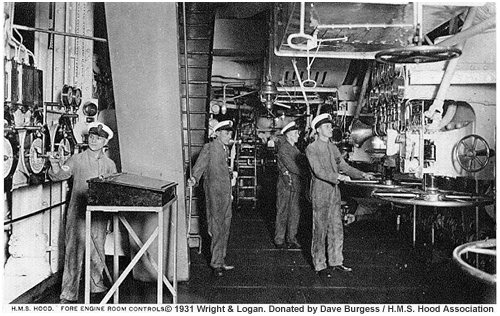
Engine room throttle action in the Hood, 1931

By the 1930s, the Hood (like the Royal Navy) was still highly revered and magnificent outwardly, but old, rusty and rotten inside. Constant leaking promoted rusting of bulkheads and machinery, and hampered the efficiency and integrity of her fresh water systems. Training was neglected. She was also a major player in the sad story of the Invergordon mutiny- caused by a shameful rift between the officer and crew classes in the RN.

Years of neglect wore on her. By the late 1930s, she was weighted down by the weight of many layers of paint (tons), tons of new equipment; she rode low in the water and she still leaked constantly. Training was improved, but the ship was aging. There were newer ships in the RN, and many more modern ships in several navies of the world. She was still the pride of the Royal Navy, but her sad fate awaited her.


The Hood's stoker crews, May 1941.
Most of these men went down with the ship;
many died at the same moment, just after 6AM on May 24, 1941.


WW2 came quickly, and planned improvements would have to wait. Like the Royal Navy, she had been rushed into service, somewhat unprepared, but fought gallantly. In the end, her demise punctuated the decline of the Royal Navy. In 1941, she was sunk by the Battleship Bismarck, a brand new German battleship, the Hood being well over 20 years in service at that time.


The last view of the once Mighty Hood, May 24, 1941.
The ship and her crew of almost 1500 were gone within 3 minutes.


All these images are from the book, and can be found all over the web. The book also contains some wonderful cut-away views and schematics. But more that that, the full story of the Mighty Hood from start to finish is contained within this book.

I enjoyed this book enormously, and would recommend it to any history or navy enthusiast.

Sunday, 6 July 2014

Photos from a few years ago

Took some photos at the weekly Kanata Cruise Night Car Show at Hazeldean Mall in Kanata. This was some 3 or 4 years ago. That's #1 and #2 in a 1950s 3-wheeled car from Germany. I think it's called a Messerschmidt KR200. That's the same company that built German fighter planes in WW2.
Here's the boys in the car:

Here's the car without the boys:

#1 son is actually driving now, and it's debatable whether or not he could fit into this thing now...

Monday, 19 May 2014

Science explained properly

Just saw this awesome image describing the origin of the Pluto-Charron planet-moon system. Here is what I love about it. It describes the favored theory of the day on how the system originated. It also tells us why the theory is favored. It also tells us what the drawbacks of the theory are. When we present scientific theory to the layman, we should always, ALWAYS be doing it in this way.

Pluto Charron system origin

It isn't always done this way. In fact, when experts discuss the newest and most exciting cosmological theories - dark matter, dark energy, inflation, string theory, etc., they rarely, if ever, present the pro's and con's. They present these theories as if they're done deals. Case in point, Neil deGrasse-Tyson, in the 5th installment of Seth MacFarlane's awesome Cosmos redux series on the Fox Network, describes dark matter in a way that suggests that it is a certainty - as if it exists as sure as the sands on you fave beach exist. Well, the truth is that we NEED it to exist, to keep current cosmological theory tied together. Now it may very well exist, but our theories could just as likely be flawed, or even ** shudder ** incorrect. It's not like there are beakers of the stuff in chemistry labs at MIT or anything.
Time to be thorough and honest here, kids. Especially you, NDT!