Tuesday, 17 February 2015

And another book: Gateway

Gateway

Frederik Pohl

 GatewayI read this on recommendation from someone on the io9 online blog. I love hard science fiction, and this was the best one I've read in over a year. Set in the near-future, after people from Earth have colonized Venus and Mars. There was some terrific technological foresightedness on behalf of Pohl- ship communication via laser (cool), the idea that healthcare in the future would be very costly, and would be something that most people would be intensely aware of (nailed it). Also, homosexuality was treated as a common thing- a pretty advanced concept coming from a book written in the 1970's (at about the same time as Anita Bryant's rantings). On the other hand, I found it difficult to identify with the protagonist after he beats the crap out of his girlfriend! (I also found it odd that she would forgive him.) I could not understand the concept of smoking in a confined space ship, but that was a definite 20th century thing.

Spoiler alerts.

The book's theme is discovery and loss - about newly discovered alien (Heechee) technology that allows faster-than-light-speed travel. The technology is being used to explore the galaxy, and to obtain artifacts for financial gain. A secondary background storyline takes place in the future, as a recollection after the major events of the main storyline. The book jumps back and forth, but they're nicely tied-up at the end. The climax involves an expedition using an alien ship towards a black hole. Only the protagonist returns (as a rich man), and we're not quite sure if the others (including his girlfriend) were stranded there by accident, or on purpose. Nicely done.
This was a terrific read, and I've already received the follow-up in the mail; it will be my next read...

Monday, 2 February 2015

Trophy Presentations to Championship Teams

Watched the Superbowl on the weekend, and something occurred to me about the presentation of the trophy to the winning team.

The National Hockey League (NHL) does it right. The National Football League (NFL) and Major League Baseball do it wrong.

The NHL Crowning Event
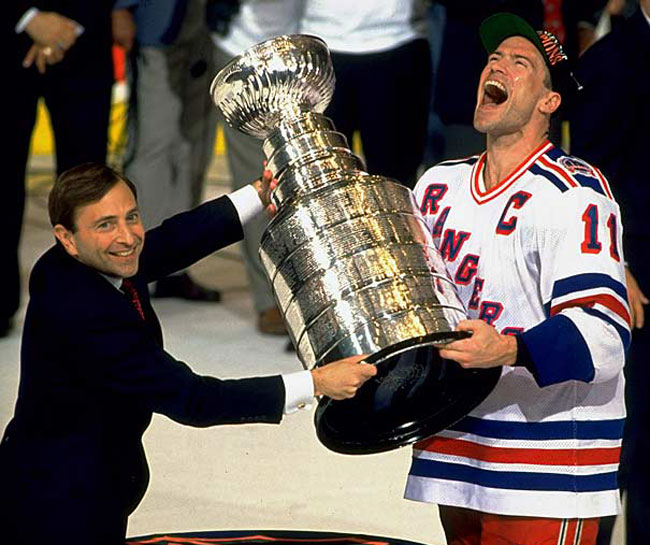
When the NHL crowns its champion, the league president says very little, and presents the championship trophy to the players- specifically, to the winning team's player captain. The celebration begins immediately- the people that matter- players and fans are center stage. The old fart team owners and executives and the league president and executives are not an integral part of the celebration. 
Here's what is looks like when the NHL does it:


Gee, Messier looks pretty happy, and I bet the Rangers fans loved this!

The NFL black suit Event
The NFL gives us a mini state of the union speech from the hated league president, followed by presentation of the trophy to an old sod of a rich guy in a suit. The old owner in a suit then makes his speech for a while. Meanwhile, the people that matter, the players and the fans, stand around until the suits have their glory orgy. Nobody wants to see the president hand the trophy to an old guy in a suit. Nobody has tears in their eyes thinking about how much money that poor owner had to spend to buy a championship. Nobody reflects upon what that rich guy in a suit must have been going through watching that game from his luxury suite. 
Here's what it looks like when the NFL does it:


Hmmmm. Not the same thing, really, is it? Bill Belichick looks not sad. Patriots owner Robert Craft looks rich. And how do the players feel about this moment? I guess that's not really important.

The MLB black suit Event
Major League Baseball gives us little more- the only plus is that the baseball owners are usually a bit older, the trophy is more fragile-looking, and there's always the chance that the old guy in the suit might drop the thing, or drop dead on top of it.
Here's what it looks like when Major League Baseball does it:


Ummmm. What team won? Well, it says 2013 World Series, so I guess it's the Red Sox. John Farrell (far right, not near the trophy) looks not sad. I think some of those other people in black suits played a major role in beating the Cardinals that day. I guess.

The point?
The NFL and Major League Baseball need to have a look at how the NHL does it, and take a lesson. The best presentation. For the players. For the fans. No one else matters here. Nobody cares what people in black suits have to say after a championship game. For the most part, nobody even cares who they are, or if they were even there. Really, you guys; nobody.

Tuesday, 27 January 2015

Another book: HMS Hood


The Battlecruiser HMS Hood, an Illustrated Biography

Bruce Taylor

It’s a coffee table book, I guess, but it’s filled with information and images if the late great British Battlecruiser HMS Hood.

I've always been fascinated by large fighting ships- their grandeur, power and grace- and the roles that they played in major conflicts in the 20th century. Later, I became obsessed with the idea that a ship with hundreds of persons on board - a virtual floating city- could be destroyed and sunk - with all those people in a matter minutes. Where were they when they perished? Why couldn't they get out? This book answered many questions for me.

HMS Hood started life as a ship among ships- more modern, more glorious, more everything than any other ship in any other navy. She had 15 inch guns, was capable of well over 30 knots and carried her officers and crew in more comfort that any fighting ship before her. She was the biggest ship ever built for the Royal Navy.

HMS Hood on its World Tour, Melbourne, Australia, 1924 


HMS Hood leaving Hawaii on its world tour, 1924


HMS Hood was designed by the same people that designed the original WW1 battlecruisers that played a major role at the battle of Jutland-- and paid a heavy price. Designed to arrive fast, fight at close range, escape and repeat, they were at great disadvantage fighting it out at long range against battleships. The British were aware of this disadvantage in WW1, and were no less aware of it in 1941. Her range-finding equipment was inferior to the equipment used by the most modern fighting ships, and she used a more volatile gun propellant than the Germans or Americans did in WW2. All these facts would play a role in her fate.

Left: The Torpedoman's mess-deck. Right: The Officer's Wardroom


The Torpedomen crew ate, lived and slept in their mess (there were several). They ate at those tables, then slept above them in hammocks- in very close quarters. This is from 1931. Officers ate and drank in the Officer's Wardroom. They had separate quarters for sleeping. This is from 1932.

The lifetime of HMS Hood closely reflects the decline of the Royal Navy. In the 1920s, Britannia ruled the waves, and the Hood was the star of a Royal Navy world tour that circumnavigated the globe. It was the apex of her glory- she was the biggest, fastest, most powerful ship in the world. But there was much change over her 20+ years- she changed over time, as did the world- and she couldn't keep up.
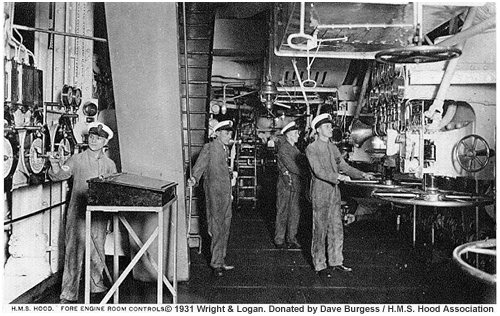
Engine room throttle action in the Hood, 1931

By the 1930s, the Hood (like the Royal Navy) was still highly revered and magnificent outwardly, but old, rusty and rotten inside. Constant leaking promoted rusting of bulkheads and machinery, and hampered the efficiency and integrity of her fresh water systems. Training was neglected. She was also a major player in the sad story of the Invergordon mutiny- caused by a shameful rift between the officer and crew classes in the RN.

Years of neglect wore on her. By the late 1930s, she was weighted down by the weight of many layers of paint (tons), tons of new equipment; she rode low in the water and she still leaked constantly. Training was improved, but the ship was aging. There were newer ships in the RN, and many more modern ships in several navies of the world. She was still the pride of the Royal Navy, but her sad fate awaited her.


The Hood's stoker crews, May 1941.
Most of these men went down with the ship;
many died at the same moment, just after 6AM on May 24, 1941.


WW2 came quickly, and planned improvements would have to wait. Like the Royal Navy, she had been rushed into service, somewhat unprepared, but fought gallantly. In the end, her demise punctuated the decline of the Royal Navy. In 1941, she was sunk by the Battleship Bismarck, a brand new German battleship, the Hood being well over 20 years in service at that time.


The last view of the once Mighty Hood, May 24, 1941.
The ship and her crew of almost 1500 were gone within 3 minutes.


All these images are from the book, and can be found all over the web. The book also contains some wonderful cut-away views and schematics. But more that that, the full story of the Mighty Hood from start to finish is contained within this book.

I enjoyed this book enormously, and would recommend it to any history or navy enthusiast.

Sunday, 6 July 2014

Photos from a few years ago

Took some photos at the weekly Kanata Cruise Night Car Show at Hazeldean Mall in Kanata. This was some 3 or 4 years ago. That's #1 and #2 in a 1950s 3-wheeled car from Germany. I think it's called a Messerschmidt KR200. That's the same company that built German fighter planes in WW2.
Here's the boys in the car:

Here's the car without the boys:

#1 son is actually driving now, and it's debatable whether or not he could fit into this thing now...

Monday, 19 May 2014

Science explained properly

Just saw this awesome image describing the origin of the Pluto-Charron planet-moon system. Here is what I love about it. It describes the favored theory of the day on how the system originated. It also tells us why the theory is favored. It also tells us what the drawbacks of the theory are. When we present scientific theory to the layman, we should always, ALWAYS be doing it in this way.

Pluto Charron system origin

It isn't always done this way. In fact, when experts discuss the newest and most exciting cosmological theories - dark matter, dark energy, inflation, string theory, etc., they rarely, if ever, present the pro's and con's. They present these theories as if they're done deals. Case in point, Neil deGrasse-Tyson, in the 5th installment of Seth MacFarlane's awesome Cosmos redux series on the Fox Network, describes dark matter in a way that suggests that it is a certainty - as if it exists as sure as the sands on you fave beach exist. Well, the truth is that we NEED it to exist, to keep current cosmological theory tied together. Now it may very well exist, but our theories could just as likely be flawed, or even ** shudder ** incorrect. It's not like there are beakers of the stuff in chemistry labs at MIT or anything.
Time to be thorough and honest here, kids. Especially you, NDT!

Monday, 16 September 2013

And another book again

Robot City, Isaac Asimov's, Book One: Odyssey

M.P. Kube-McDowell

I bought this book thinking that it was written by renown science fiction author Isaac Asimov. After it lived on my bookshelf for a year, I picked it and paid more attention to it than when I bought it, and was momentarily disappointed. With a more detailed look at the cover, I noticed that it just says Isaac Asimov above the title, with an apostrophe-S appended to the name, and another writer's name in fine print near the bottom... Uh-oh, I thought, I think I've seen this type of thing before... However, I decided to give it a chance, ready to back out at the slightest hint of boringness. So I read the intro by Isaac Asimov, where he was kind to the actual author (as you would expect / hope), and also to an illustrator- one Paul Rivoche, whom, as it turns out, I knew in high school. My interest immediately rekindled, I dove in. (The illustrations are great, by the way--- I bought the book because of Asimov's name, the cool sounding title, and the way cool cover art--- I am often suckered in by cool images like this.) 
The book seems to be written with Asimov's famous (to geeks, anyway) three laws of robotics as a major and ever-present theme element, which worried me, initially. That aside, it is actually a pretty good read- it includes a protagonist marooned astronaut, robots, space raiders, good aliens, bad aliens (including a really bad antagonist alien), a mysterious female, space ships, cool technology, more robots, and of course, a great big robot city. Fairly light reading, but I want to read the second book now!

Wednesday, 4 September 2013

And still another book

Winds of Change
Asimov, I.

After a serious "history" read, I needed a SciFy escape- how about something from one of the masters- Isaac Asimov...
The Winds of Change: 20 or so short stories by Isaac Asimov; some pretty good, some pretty dull. Here's a summary:
Perfect Fit: A criminal's punishment is being forced to forget how to use computers.
Belief: A man discovers that he can levitate; nobody will believe him, so a friend explains that he must find a way to help others to help him investigate the phenomenon.
A Fair Exchange: A scientist learns how to travel in time and make very slight adjustments; and ruins his life...
For the Birds: A man discovers a way for humans to move within the thin atmosphere of space stations.
Found: Two technicians discover than mankind has been discovered by metal life forms.
Good Taste: Nope, too boring; skipped this one after 2 pages...
How it Happened: Historians Aaron and Moses record history taking place over six days because they don't have enough papyrus on hand...
Ideas Die Hard: The first men to travel to the moon aren't- they're just in a simulation.
It Is Coming: Alien computer approaches Earth; humans scramble to tune their best computer to communicate with it; the computer is accepted into the computer society.
The Last Answer: A man dies, is selected by an immortal and omnipotent being offering immortality- to think of a way to end its existence...
The Last Shuttle: The last space shuttle takes the last humans off Earth for the last time...
Lest We Remember: An average man takes experimental drug to make him extraordinary; his wife ensures that he reaches his potential.
Nothing for Nothing: Visitors from space trade with prehistoric man- technology for art.
One Night of Song: Man grants a wish to another man- his ex-girlfriend is permitted to sing perfectly- for one performance only...
The Smile That Loses: Man grants a with to a woman- a photo of her husband smiling- a husband that never smiles...
To Tell at a Glance: Young woman must identify a spy amongst a group of dignitaries.
The Winds of Change: A scientist learns how to travel in time and makes changes that affect things (yawn).

I like Asimov, but not all of his stories. I'd like to read a novel of his, but how to know if it will be one of his good ones, or another Good Taste or Lest We Remember....