Here's the album cover and the scene side-by-side:
Saturday, 2 November 2019
New Order and Gregory Peck
Has anyone ever noticed that the cover art from the 1980's New Order album Low-Life look a lot like a scene from the movie Twelve O'Clock High where Gregory Peck cracks under pressure?
Here's the album cover and the scene side-by-side:
Well, it's pretty close, eh?
Here's the album cover and the scene side-by-side:
Tuesday, 24 October 2017
Seven characteristics are in an uncultivated person, and seven in a learned one
![]() |
| A golem |
Psalm 139:16 mentions the term golem - my unformed body. Means my light form, raw material, connoting the unfinished human being before God's eyes. The Mishnah (in the Hebrew bible) also relates the characteristics of an "unformed" person (dumb, helpless, uncultivated) as compared to a fully formed, learned, cultivated person.
A learned person:
(1) does not begin speaking before one who is greater than
he in wisdom or in years
(2) does not interrupt the words of his fellow
(3) does not answer impetuously
(4) questions with relevance to the subject and replies accurately
(5) discusses first things first and last things last
(6) about something he has not heard he says, “I have not heard”
(7) acknowledges the truth.
Characteristics that we could all stand to adopt?
Saturday, 17 December 2016
Another disappointing Heinlein book
The Moon is a Harsh Mistress
Robert A. Heinlein
I waited a long time to read this book, and I was a little disappointed. I guess if many people say that it is one of the best science fiction books ever, how can you live up to that? This is my 3rd Heinlein book, and I’d say that it falls in the middle between Starship Troopers (very good) and Stranger in a Strange Land (quite disappointing). I could identify with all the characters in The Moon is a Harsh Mistress, but it was less a sci-fi book than it was a political revolution thriller, with a sci-fi back-drop. Now that’s not completely fair, since one of the main characters was an intelligent computer, but it was mostly about revolution.
As a book written in the early 1960’s (and read in 2016), Heinlein did a decent job of predicting the future. He correctly predicts that China is a major player in the future (not the case in the 1960s). He also predicts artificial intelligence nicely, and his description of living life on the moon was very accurate and believable.
He also seems to see that software would be important in computing, but missed the decreasing size and importance of hardware - that would have been tough to guess.
All of the tech - like space suits and pressure domes under the surface - made sense, and so did the ability of lunar inhabitants to modify laser drills into weapons. Spaceships orbiting, orbital dynamics and trajectory were all well thought out.
Forgivably, he did get a few things wrong - he came up with this idea that being in space (or on the moon) for any amount of time physiologically changed your body forever, meaning that you could not return to Earth (but maybe he needed that for the story).
Disappointingly though, he got communications all wrong - telephone sets, cables and a central office will apparently always be needed; didn’t foresee anything like cell phones (certainly walkie-talkies were around in the 60’s; that could have been a hint). And newspapers were still a thing for the latest news, however, that may have been tough to guess in the 60s.
He also dreamed up social structures that were unique to the moon - where there were too many men and not enough women. The result was complex sharing marriages with multiple women and multiple (and more) men.
The story plodded along for a long while detailing the progress of the revolution. It wasn’t until the final 50 pages (of 300) where the action got intense. After that, it was quite good.
However, I think I’m done with Heinlein. Well, at least for the foreseeable future...
Thursday, 21 July 2016
Throwing a baseball
Growing up as a kid, nobody ever taught me to throw a baseball. I just learned by trial and error. In fact, everything I knew about baseball up until I was over 40, was learned by observation and trial and error. Well, there was the time when I asked Bob Allisat how to hit a fast pitch, and he told me to keep my feet together and step into the pitch as the pitcher threw the ball. He was mostly right, and it helped a lot. That's about it, though.
I learned from watching friends, and watching baseball on TV. I did have a certain amount of natural ability - I was a fast runner, which helped me overcome my many mistakes in fielding and my lack of knowledge of positioning. But I learned these things too, by watching friends, competitors and the Montreal Expos. Watching pro outfielders (especially Andre the Hawk Dawson, perhaps my fave player ever) cured me of throwing side-arm from the outfield. Watching other fielders taught me to communicate verbally with other fielders while tracking down fly balls and grounders.
But I didn't really understand the game until I was over 40 and started coaching my own kids (and other people's kids). At first, I was an assistant coach, and learned a heck of a lot from John, Warren, Pat and Rob. After two years, I could teach stuff that I didn't know two years earlier. Tons of stuff. Being strictly an outfielder, I knew very little about the infield. In fact, I had no idea how to play any of the positions. Not really. Two years later, I could teach them. The most important thing I learned was the "ready position" - that's 50% of it right there. Knowing what to do THAT PLAY, based on the number of outs, and where the base runners are. That's another 25% right there. 75% of the way to being a good infielder right off the bat (pun intended).
I then watched pitching coaches teach pitching to my kids - and learned a lot from both Dave and Warren. A whole lot. Now I can take a kid, show him a few things, and turn him into a pitcher. At least a relief pitcher. (Assuming he has some basic throwing skills already- which is not always the case.) Which takes me to throwing a ball.
As I said, I had some natural ability, a strong arm and some not totally bad technique. (Stopped throwing side-arm before high school.) There's more throwing than a strong arm, though. In fact, while arm strength is 50% of it, technique is everything else. You use your whole body - including your legs - to throw a ball. I see youth pitchers using only their arms, and doing well. I can only imagine how much better they could do if they would just use some proper technique. Eric, I'm talking to you.
Now have a look at this picture. This is Nomar Garciaparra, who was a big star shortstop for the Boston Red Sox in the 1990s and early 2000s. Here, with the Cubs, while tossing the ball in the infield, he shows us one of the most important aspects of throwing a ball. A proper wind up. I'm not talking about the complicated pitcher's windup like in the way cool image below, but rather just a simple start to a basic throw. Like tossing the ball from shortstop to first base between innings, warming up before the game, tossing a ball with a pal, etc.
Football guys will do something similar, but will cradle that ball (like it was a football) with hand facing upwards. Incorrect for baseball. An extended arm with the hand (and ball) facing down is the correct way to start your throwing motion. Many good athletes can throw just fine (results-wise) not doing this. But like anything else, using proper technique will improve your game no matter how well you're doing with improper technique. If you're throwing accurately 90% of the time with poor technique, you'll get closer to 100% using proper technique.
More importantly though, a kid throwing accurately 50% of the time or less, using improper technique, will dramatically improve accuracy (and velocity) using proper technique. If you're not starting your throwing motion like that, do it, and see the difference. And even more importantly, get your kid to start his throwing motion like this. It matters, and it will definitely make a difference.
I learned from watching friends, and watching baseball on TV. I did have a certain amount of natural ability - I was a fast runner, which helped me overcome my many mistakes in fielding and my lack of knowledge of positioning. But I learned these things too, by watching friends, competitors and the Montreal Expos. Watching pro outfielders (especially Andre the Hawk Dawson, perhaps my fave player ever) cured me of throwing side-arm from the outfield. Watching other fielders taught me to communicate verbally with other fielders while tracking down fly balls and grounders.
But I didn't really understand the game until I was over 40 and started coaching my own kids (and other people's kids). At first, I was an assistant coach, and learned a heck of a lot from John, Warren, Pat and Rob. After two years, I could teach stuff that I didn't know two years earlier. Tons of stuff. Being strictly an outfielder, I knew very little about the infield. In fact, I had no idea how to play any of the positions. Not really. Two years later, I could teach them. The most important thing I learned was the "ready position" - that's 50% of it right there. Knowing what to do THAT PLAY, based on the number of outs, and where the base runners are. That's another 25% right there. 75% of the way to being a good infielder right off the bat (pun intended).
I then watched pitching coaches teach pitching to my kids - and learned a lot from both Dave and Warren. A whole lot. Now I can take a kid, show him a few things, and turn him into a pitcher. At least a relief pitcher. (Assuming he has some basic throwing skills already- which is not always the case.) Which takes me to throwing a ball.
As I said, I had some natural ability, a strong arm and some not totally bad technique. (Stopped throwing side-arm before high school.) There's more throwing than a strong arm, though. In fact, while arm strength is 50% of it, technique is everything else. You use your whole body - including your legs - to throw a ball. I see youth pitchers using only their arms, and doing well. I can only imagine how much better they could do if they would just use some proper technique. Eric, I'm talking to you.
Now have a look at this picture. This is Nomar Garciaparra, who was a big star shortstop for the Boston Red Sox in the 1990s and early 2000s. Here, with the Cubs, while tossing the ball in the infield, he shows us one of the most important aspects of throwing a ball. A proper wind up. I'm not talking about the complicated pitcher's windup like in the way cool image below, but rather just a simple start to a basic throw. Like tossing the ball from shortstop to first base between innings, warming up before the game, tossing a ball with a pal, etc.
Football guys will do something similar, but will cradle that ball (like it was a football) with hand facing upwards. Incorrect for baseball. An extended arm with the hand (and ball) facing down is the correct way to start your throwing motion. Many good athletes can throw just fine (results-wise) not doing this. But like anything else, using proper technique will improve your game no matter how well you're doing with improper technique. If you're throwing accurately 90% of the time with poor technique, you'll get closer to 100% using proper technique.
More importantly though, a kid throwing accurately 50% of the time or less, using improper technique, will dramatically improve accuracy (and velocity) using proper technique. If you're not starting your throwing motion like that, do it, and see the difference. And even more importantly, get your kid to start his throwing motion like this. It matters, and it will definitely make a difference.
Tuesday, 19 July 2016
The skewing of the Political Specrum
I have been saying to my conservative friends - those who insist that they are just a bit right of center - that their views are skewed. Their perspective is distorted. I'm talking about folks in the US who think that communism and socialism are the same thing (completely incorrect), and folks in Canada who think that liberalism and socialism are the same thing (equally incorrect).
For a while I was mystified by this obviously flawed perception - I mean, okay there are a lot of dummies out there, but for the most part, conservative people that I know personally aren't dummies, in fact many are quite smart. So how do you explain a smart person being unable to tell the difference between two very different things? I mean socialism and communism are about as similar as sliced bread and a car battery. How can a smart person not see that?
I struggled with this for some time until about a year ago (or two?) I was engaged in a discussion on io9 or Quora with an American Republican who kept using the term "leftists" when describing people, and the 'leftist media' etc. I objected to the latter, but the former got me thinking. Clearly, there are few if any "leftists" in America. I mean the US Communist Party is and has been poison since the McCarthy era, and I wasn't aware of any actual official socialist parties in the US. So I asked him to please list some "leftist" organizations currently active in America. His answer threw me for a loop - he listed no fewer than 50 of them.
Well, the list contained the names of 50+ organizations. But they were all civil rights organizations like the NAACP, Kansas Commission on Civil Rights, National Voting Rights Institute, and many others. Egad!! Those are what he thought were "leftist" organizations? Then I had a eureka moment: It's all about perspective.
Have a look at this image:
On the left, we have the political left; on the right, the political right. Anyone who attended a single class of political science (or has ever strayed from the sports or funnies in a newspaper) will tell you that on the extreme left is communism (some would insist that we say 'ideal communism' but that's only a theoretical thing), and on the extreme right is fascism or nazism.
In a normal (or perhaps theoretical) world, we could map out where the American and Canadian political parties lay on this grid:
For the most part, they all tend toward the center, some being more left, others being more right, some more authoritarian, some less. I hope nobody is insulted by this map; I think it's fair from the perspective of the reasonable person, whatever their political leanings may be. Now to be honest, I really don't understand the Greens, so I just put them there for no reason. They actually don't interest me that much. Sorry.
So back to perspective. First, I have to say that I don't think there are many moderate conservatives or republicans anymore. Most of them have gone to the far right. This is a generalization of course- and while someone like Mitt Romney may actually be a moderate Republican, he has been soundly rejected by his party (and not just once), and does not represent mainstream Republican thinking today. Most Republicans are ideologically far to the right of Mr. Romney. So this movement to the right in and of itself affects the perspective of most Republicans - their position on the grid affects how they see others. I am focusing on the US Republicans here, but exactly the same can be said about Canadian Conservatives- at least the former Harper administration. The graph below illustrates what I mean:
For me, this explains a lot of things. How can a sane and intelligent person see different things, and think they're the same? By looking at them from a great distance. From the far right, commies, socialists and dems look the same - so do those Canadian libs. They're all a bunch of "leftists"...
It's like looking at the Rocky Mountains from downtown Calgary. There are a whole lot of mountains over there, and they all look pretty much the same. Some a bit taller, some less so. Most are gray-green, lots have white at the top. And they're all way over there. They're all a bunch of "mountains"...
For a while I was mystified by this obviously flawed perception - I mean, okay there are a lot of dummies out there, but for the most part, conservative people that I know personally aren't dummies, in fact many are quite smart. So how do you explain a smart person being unable to tell the difference between two very different things? I mean socialism and communism are about as similar as sliced bread and a car battery. How can a smart person not see that?
I struggled with this for some time until about a year ago (or two?) I was engaged in a discussion on io9 or Quora with an American Republican who kept using the term "leftists" when describing people, and the 'leftist media' etc. I objected to the latter, but the former got me thinking. Clearly, there are few if any "leftists" in America. I mean the US Communist Party is and has been poison since the McCarthy era, and I wasn't aware of any actual official socialist parties in the US. So I asked him to please list some "leftist" organizations currently active in America. His answer threw me for a loop - he listed no fewer than 50 of them.
Well, the list contained the names of 50+ organizations. But they were all civil rights organizations like the NAACP, Kansas Commission on Civil Rights, National Voting Rights Institute, and many others. Egad!! Those are what he thought were "leftist" organizations? Then I had a eureka moment: It's all about perspective.
Have a look at this image:
On the left, we have the political left; on the right, the political right. Anyone who attended a single class of political science (or has ever strayed from the sports or funnies in a newspaper) will tell you that on the extreme left is communism (some would insist that we say 'ideal communism' but that's only a theoretical thing), and on the extreme right is fascism or nazism.
In a normal (or perhaps theoretical) world, we could map out where the American and Canadian political parties lay on this grid:
For the most part, they all tend toward the center, some being more left, others being more right, some more authoritarian, some less. I hope nobody is insulted by this map; I think it's fair from the perspective of the reasonable person, whatever their political leanings may be. Now to be honest, I really don't understand the Greens, so I just put them there for no reason. They actually don't interest me that much. Sorry.
So back to perspective. First, I have to say that I don't think there are many moderate conservatives or republicans anymore. Most of them have gone to the far right. This is a generalization of course- and while someone like Mitt Romney may actually be a moderate Republican, he has been soundly rejected by his party (and not just once), and does not represent mainstream Republican thinking today. Most Republicans are ideologically far to the right of Mr. Romney. So this movement to the right in and of itself affects the perspective of most Republicans - their position on the grid affects how they see others. I am focusing on the US Republicans here, but exactly the same can be said about Canadian Conservatives- at least the former Harper administration. The graph below illustrates what I mean:
For me, this explains a lot of things. How can a sane and intelligent person see different things, and think they're the same? By looking at them from a great distance. From the far right, commies, socialists and dems look the same - so do those Canadian libs. They're all a bunch of "leftists"...
It's like looking at the Rocky Mountains from downtown Calgary. There are a whole lot of mountains over there, and they all look pretty much the same. Some a bit taller, some less so. Most are gray-green, lots have white at the top. And they're all way over there. They're all a bunch of "mountains"...
Wednesday, 16 March 2016
Another Book: Rome and Italy by Livy
I read this book right after I read his "Early History of Rome" - and that was quite some time ago. Again, to salvage what I could from my memory (thanks to my margin markings), here is what I got from this piece. Spoilers ahead, many spoilers. But then, it's not like there are any secrets here...
This book continues from Livy’s “The Early History of Rome” with five subsequent ‘books’ - 6 through 10. This work covers the period from the Gallic (Celtic) sack of Rome in 386 B.C. until when the Romans began dominating most of Italy in 292 B.C.
This book was very similar in style to the first, and to be fair, the arrangements of books are a function of the translation, so the similarity is no surprise. I still really liked this subject matter, so I had to give it 4 stars again...
4 starts out of 5 ****
Rome and Italy
Livy
This book continues from Livy’s “The Early History of Rome” with five subsequent ‘books’ - 6 through 10. This work covers the period from the Gallic (Celtic) sack of Rome in 386 B.C. until when the Romans began dominating most of Italy in 292 B.C.
Book Six re-summarizes some of the events leading up to and following the Gallic sack of Rome. Important figures were Roman general Camillus, who defeated the Gauls, and defended Rome against local rivals as Rome slowly recovered from the Celtic defeat, and Manlius, a former Consul who had aspirations of the throne, and was executed. (However, this may have been just a story to cover the fact that he championed the plebeians to the disgust and anger of the patricians.) In 367 B.C., the Gauls made another attack, but were easily defeated by the Romans this time.
Book Seven covers the period from 365 to 342 B.C. Socially, rebuilding the city was a crushing financial burden to the plebeians, so changes to the rate of interest improved their lot. Militarily, just 17 years after the defeat, the Romans were able to field 10 legions. Around 350 B.C. a large Gallic army again appeared in Latin territory, and was defeated with great loss to the Gauls. Greek pirates made a show near the mouth of the Tiber, but were easily defeated when they landed. Also covered is the first conflict with the Samnites of south and central Italy, with the Romans winning several battles.
Book Eight Covers the period from 341 to 322 B.C. generally known as the first Samnite war. However, it begins with another short battle with the Volscians. Livy takes the opportunity here to describe the make-up and fighting strategy of the Roman army. A good time because the Romans now had to fight some of their fellow Latins, who had long been allies, and with whom they had fought side-by-side, and used the same weapons and techniques. The Romans won, with the unlikely aid of the Samnites, but at great cost to both sides. Rome would recover, and retain much of the territory of the vanquished Latins. And of course, more fighting against the Samnites.
Livy mentions the rise of Alexander the Great at this time, as well as the founding of the city of Alexandria in Egypt. And in 326 B.C., the Romans made a law that a creditor may seize the property of a debtor, but may not seize or imprison the debtor’s person.
Book Nine Covers the period from 321 B.C. to 304 B.C., generally known as the second Samnite war. It starts with the Roman army coming to the aid of allies being besieged by the Samnites. On their way they are ambushed by a Samnite army, and forced to give up hostages (their cavalry), to strip their uniforms and their arms, and to proceed under the yoke. Here is a paining of the event (click for more info).
![]() |
| Romans passing under the Samnite yoke |
Having considered two options - let the Romans go, and guarantee friendship, kill them all, and guarantee a weakened Rome for a generation, they instead chose to humiliate- a decision that would do them no good in the end.
A second Roman army laid siege on an Apulian city garrisoned by Samnites and won a victory, freeing the hostages, and forcing Samnites under the yoke. The general here was Papirius Cursor, whom Livy insists could have bested Alexander the Great, had he came the way of Italy. (A bit of hubris, perhaps?)
After some treaties with Samnites and some lesser Greek cities (in the east and south of Italy), the Romans began sending envoys (patrons) who purpose was to introduce Roman law, and thus began the spread of Roman law (and culture) though Italy. As the second Samnite war drew to a close, the Romans began to be concerned with the Etruscans, and they began fighting on two fronts. Etruscans had great numbers, but were not as organized, and soon paid a heavy price for that, after which the Romans granted them a 30 year truce. At the same time, the Samnites prepared for a great push, but were badly beaten, and agreed to supply Rome with corn and payments. Livy mentions that at this time a treaty with Carthage was agreed to, extended for a third time.
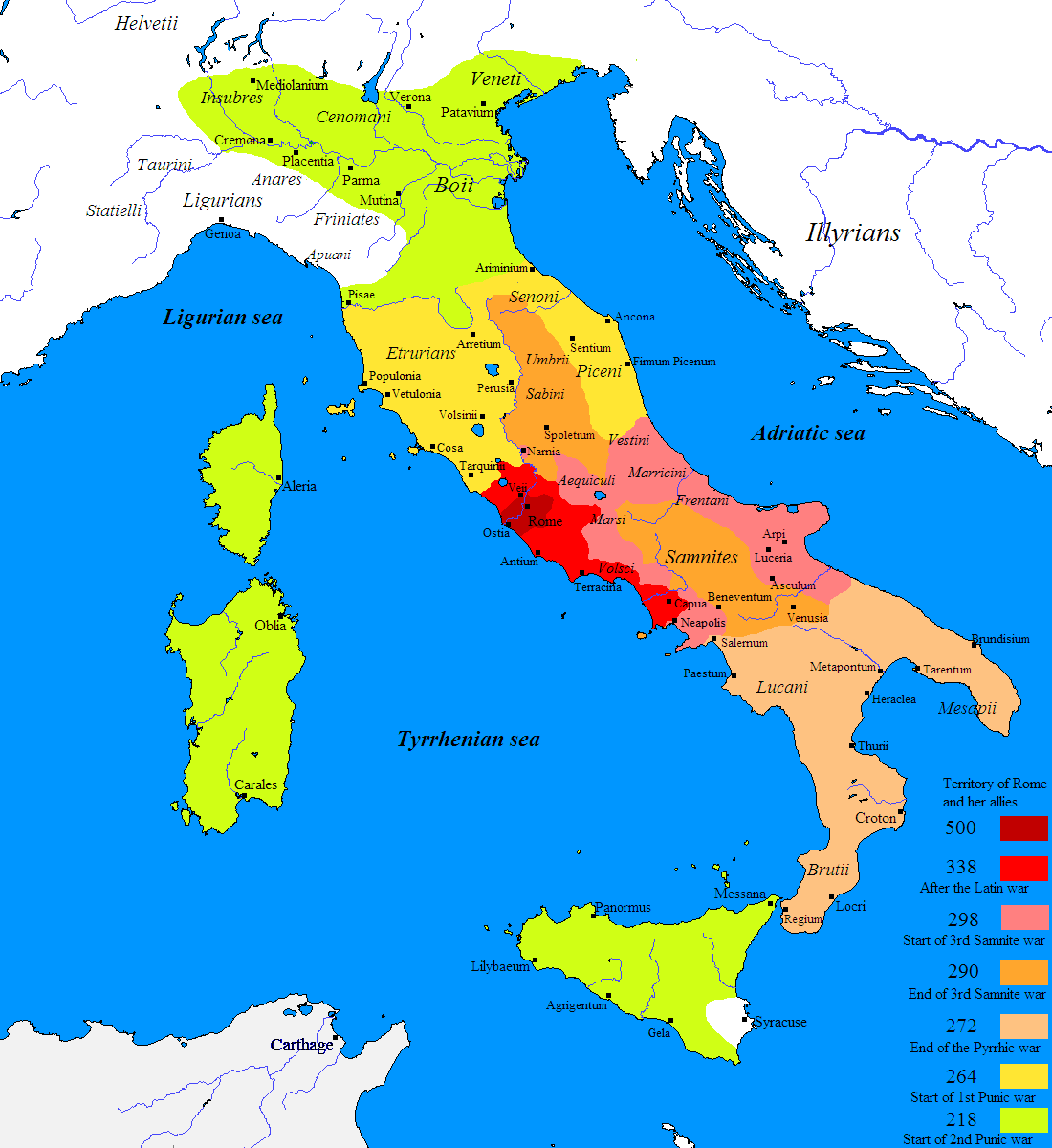
| Roman Conquest of Italy |
Book Ten Covers the period from 302 B.C. to 292 B.C. Generally know as the third Samnite war. Starts with the Aequi revolting and being crushed, followed by the invasion of a small town in the east by Spartan Greeks, who were beaten quickly and driven back to their ships. The Marsi were also put down, and so were the Etruscans again. Finally, on suspicious grounds, the Romans decided to war again with the Samnites. In 296 B.C., the Romans faced the combined forces of the Etruscans, Samnites, Umbrians and Gauls- it seems that the Romans were on a rampage, and they were generally feared by all in Italy. Again in battle, both Samnites and Gauls were fierce, but lacked technique, and were defeated in long, pitched battles. Livy says that the Romans defeated combined armies of 600,000 infantry and 45,000 horse, but implies that these numbers may not be reliable. After more skirmishes (where many thousands more fell), the Samnite armies were wiped out, and the Romans were left to besiege their cities.
After this book, presumably Livy covers the final Roman dominance over the whole of Italy, but Books 11 thru 20 are lost to history. Fortunately, others covered this period.
This book was very similar in style to the first, and to be fair, the arrangements of books are a function of the translation, so the similarity is no surprise. I still really liked this subject matter, so I had to give it 4 stars again...
4 starts out of 5 ****
Tuesday, 8 March 2016
Subscribe to:
Posts (Atom)


